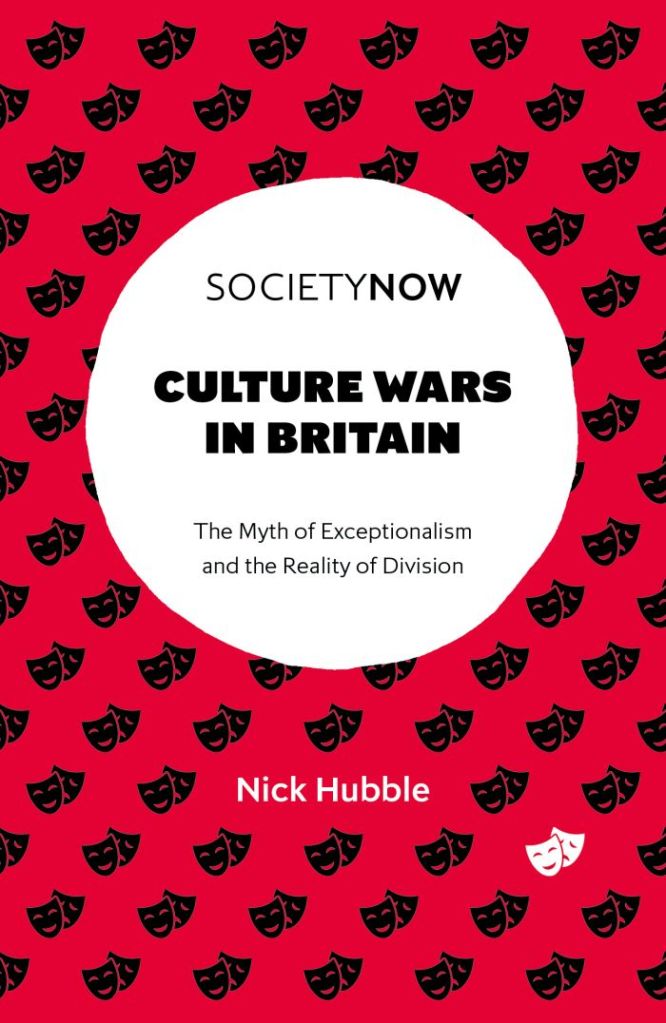
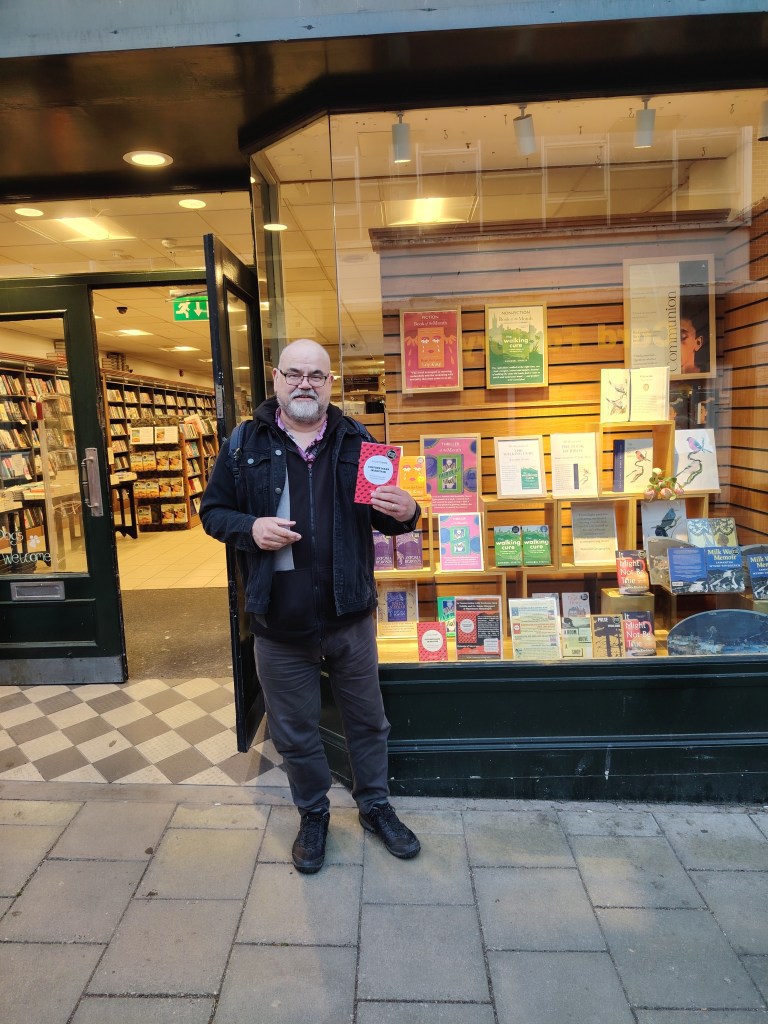
Back in May, I launched my book Culture Wars in Britain at Waterstones in Aberystwyth, where I live. This took the form of a Q&A with Dr Emma Sheppard of Aberystwyth University. This transcript is based on the detailed notes I made in advance and during the event. In several places I have added parenthetical updates on events that have happened since the launch. The book, which costs £16.99, is available to order through bookshops, Amazon and other online retailers, and direct from the publisher at this link (use the code EME30 for a 30% discount).
1. What motivated you to write the book?
As I discuss in the Preface to Culture Wars in Britain, I had been thinking about what causes social and cultural change for some years but then specifically during the Covid lockdown I became fully aware of the false narrative (it’s a conspiracy theory really) that a metropolitan elite had somehow imposed ‘cultural liberalism’ on ‘ordinary people’. At about the same time (2019-2020), repetition of both the phrases ‘culture wars’ and ‘woke’, almost always used in a negative and derogatory sense, began to cut through in mainstream media. So, I thought I need to get to the bottom of this. And that set me to planning a research project and subsequently being awarded a Leverhulme fellowship
And then I realised during 2023-2024, while actually doing the research, that I needed to write a book specifically on culture wars because:
A) Virtually all the books on this theme were being written from the socially conservative side of the argument and it was important to get out the alternative point of view.
B) There were no leftwing arguments on the other side because those on the left were sceptical of the whole idea of culture wars, as indeed many people are. So, therefore, I needed to challenge this scepticism about the idea of culture wars.
Furthermore, it became clear to me from understanding how these cultural dynamics work that I really needed to challenge the idea that we can somehow get back to ‘normal’, where ‘normal’ is imagined to be some sort of centre ground of British commonsense that can be appealed to. This idea that Britain is somehow immune to global trends is ‘the myth of exceptionalism’ referred to in my book’s subtitle. The truth is – as Professor John Curtice has repeatedly stated in recent years while discussing findings from the British Social Attitudes Survey (see, for example, here and here) – that the UK is now split on a culture-war axis between socially liberal and socially conservative blocks which now determine our politics as much as, if not more than, social class. The reason Labour have just lost so badly in the Local Elections (of May 2026) is because they are still under the misapprehension that they can appeal to the country as a whole. In trying to appeal to socially conservative Reform/Tory voters they have alienated their own base, which is overwhelmingly socially liberal, and so as a result their electoral support has fallen through the floor. So, if you want to understand why these things are happening you need to understand culture wars.
2. How important is recognising/understanding the longer arc of history in current culture wars, when it comes to building for the future? Or even in the midst of the everyday?
Culture Wars are a historical phenomenon; they’re not just a recent import from the US. Consequently, all this is not simply going to blow over or disappear in a generation or so. While the use of the term ‘culture wars’ in Britain has only become common since Brexit (although there were earlier usages), I devote a couple of chapters of my book – a chapter-by-chapter description can be found here – to outlining a history of culture wars in Britain dating from before the First World War.
One of the key arguments of my book is that employing culture wars as a concept to understand society reveals a much wider and more fluid historical process of cultural and social change than is revealed by standard sociological or historical categories. The question that really opened this up for me was the one of how culture wars differ from ‘class wars’. This led me eventually to researching and thinking about war and how it is central to the nation state, which is a hierarchical social structure that originated with the war band. A rigid binary gender divide between male/military and female/civilian is a core component of the social structure and war-making capacity of the nation state. The furious culture wars over gender, which date back even to the nineteenth century, are effectively a struggle over whether we should continue to live in hierarchical, authoritarian nation states.
In Britain, this culture war came to a head in the constitutional crisis that arose in 1910 – a year of two Kings and two General Elections – when the Liberal Government took on the House of Lords, a conflict which led to the Parliament Act of 1911. The eventual consequences of this crisis included Irish independence in 1922, massive trade union activity eventually leading to the General Strike of 1926, and universal suffrage including votes for women partially from 1918 and then on equal terms from 1928. More specifically, the constitutional crisis fractured the Victorian symbolic order and enabled the women’s suffrage movement to rebalance the equilibrium between genders, opening the way for roles for women outside the home. Consequently, women writers, and socialists more generally, gave voice to a new morality and actively sought for new cultural patterns of living. These changes did not just occur in Britain but across Europe, the USA and elsewhere.
However, by the late 1930s it had become clear that Fascist reaction in Germany, Spain and elsewhere was intent on destroying the feminist movement and returning women to the home, as part of a project of restoring the anti-democratic, authoritarian nation state. Even what we think of as the establishment of the Welfare State in postwar Britain was designed to reinstitute a gender binary that had begun to break down in the interwar decades by providing full employment for men and family allowances for women. We can see a historical pattern here that repeats. When that gender binary starts to breakdown, as it has during the interwar years, the 1960s and 1970s, and more recently again in the 2010s, it triggers an authoritarian reflex in defence of the power structures of the nation state. We can trace this authoritarian reflex through the moments when history ‘rhymes’: the Victorian ideal of the ‘Perfect Wife’ who was a ‘biological female’; Thatcher’s attempt to return to Victorian Values in the 1980s by insisting that ‘there’s no such thing as society, only individual men and women’; the UK Supreme Court ruling in 2025 that definitions of ‘man’ and ‘woman’ in the context of the 2010 Equality Act refer to ‘biological sex’. This authoritarian cycle will only end through either some form of apocalypse destroying nation states, or the development of a new, more sophisticated cultural pattern of living enabling the development of post-national social structures.
3. How does the framing of culture wars as American (whether an American problem or driven by Americans) – detract from our understanding and engagement with our own culture wars?
One reason that culture wars are seen as American is that the term first appeared in English in the modern sense in the American media at the end of the 1980s and was then written about by the sociologist James Davison Hunter in his 1991 book, Culture Wars: The Struggle to Define America. Hunter defined the culture wars as an irreconcilable clash between the differing values and worldviews of ‘cultural conservatives’ – those with a commitment to absolute truth and a clear and authoritative set of rules defining acceptable behaviour and our understanding of what is good and evil – and ‘cultural progressives’ – those with a rational and subjective commitment to a relativist conception of truth that is understood as continually unfolding. Rather than argue that politicians cynically use symbols of the culture war for their own ends, Hunter suggested that it’s actually culture wars which establish the parameters of political debate and the positions that politicians can take up within them. Despite this argument, however, British media and politicians have chosen to portray culture wars as cynical distractions and use the American provenance of the term as an excuse to dismiss their relevance to Britain.
Obviously, there are political differences between the US and the UK in terms of areas such as guns, abortion and race, which most British people would consider American obsessions. On the other hand, we have culture wars concerning areas such as the role of the monarchy, the House of Lords and devolution – all of which, as I was discussing earlier, date back at least to the 1910 constitutional crisis. If we concentrate on a particular topic such as abortion, then it seems as if the US and the UK are very different. But if we focus on the underlying struggles between those who wish to uphold culturally conservative fixed values and those who want to live more fluidly and flexibly, then the similarities become more apparent. This means that if we are careful then we can use American analysis to cast light on British culture wars.
For example, the work of the political scientists Ronald Inglehart and Pippa Norris shows how ‘post-materialist’ values concerned with individual free choice and self-expression have spread in the US since the 1960s across successive generations, in conjunction with liberal attitudes to race, gender and sexuality, and fluid social identities that are no longer rooted in faith, family and nation. In their 2019 book, Cultural Backlash: Trump, Brexit and Cultural Populism, they argue a tipping point was reached during the early twenty-first century, when the holders of traditional values, concerning race, gender, sexuality and morality in general, found themselves in the minority, which triggered a violent cultural backlash and authoritarian reflex. As the title of their book implies, this analysis applies equally to the UK and the US.
Attempts to portray culture wars as an unwelcome American import are generally an implicit attempt to reject ‘post-materialist’ fluidity in relation to race, gender and sexuality by socially conservative forces in British politics, such as the traditional right or the old left. There is very little serious attempt to come to terms with the consequences of the social and cultural dynamics identified by social scientists in America such as Hunter, Inglehart and Norris. Most of the British media and politicians are determined to pretend there is a British common culture of ‘ordinary people’, who are defined by a native commonsense and refusal to pay attention to anything other than ‘bread and butter’ issues. This is an incredibly patronising attitude.
What we need to realise is that the fact that Americans have an analysis of what is happening is not the problem. They don’t talk about common culture because they understand that division is real and, therefore, they talk about ways of achieving bipartisanship. They have constitutional checks and balances. We don’t have those things. We have parliamentary sovereignty, which is a pre-democratic system of winner takes all. The real problem is that in Britain we kid ourselves that we’ll be okay because it won’t be as bad as in the US, when it might well end up being much worse because there are no checks and balances and there already is an entrenched hierarchical social system rooted in the monarchy and the House of Lords.
4. Is moral panic always a marker of culture wars?
No, but I think they often manifest that way: everything from single mothers to immigration to asylum seekers and trans people. If you analyse the imaginary threat it does tend to come back to a threat to the gender binary or the social hierarchy of the nation state. A lot of the panic is over the threat to social distinction – the system of privileges that people imagine themselves as being entitled to. As the writer Richard Seymour argues in Disaster Nationalism (2024), politicians such as Trump or Farage use their celebrity status to appeal directly to the many people who have experienced ‘the loss of social distinction’ resulting from the old cultural norms and traditional values and found the experience ‘tantamount to the downfall of civilization’. For this culturally conservative constituency, the apocalyptic threat of our times is not climate change or the possibility of the Third World War breaking out, but the collapse of what they consider to be the rightful social order. As Seymour says, the panic is caused by the fear that men will become women and that whites will become black.
5. In my own work, gender and dis/ability binaries are threaded through with whiteness – how important is the unspoken nature of whiteness to understanding culture wars?
Whiteness is central to the culture wars. The direct impetus for the intensification of the culture wars in the 2020s and the sustained anti-woke anti-identity politics adopted by the media, publishers and politicians at that time was the Black Lives Matter movement and the enormous wave of street protests in the US over the summer of 2020. This was the moment when a section of the white media and academic commentariat suddenly became alarmed that their own social distinction was under threat. The result was a number of books published over the following years, such as Yasha Mounk’s The Identity Trap (2023) and Susan Neiman’s Left is Not Woke (2023), which criticize ‘identity politics’ from a supposedly leftwing perspective. These largely received approval from the press and helped set the tone for the hostile anti-woke approach which has dominated the output of the British media – including the BBC and even the Guardian – over the last few years. (This has been borne out since this interview took place, by the sustained media assault – fully participated in by the Guardian and BBC as well as the rightwing press – on the Black sociologist Professor Jason Arday, which led to him taking his own life).
The assumed division between citizens/subjects and outsiders/foreigners is central to the nation state and one of the ways that works is through visual difference and generally in Anglo-American and European countries through whiteness. Specifically in Britain this is inflected through the legacy of empire. And one of the key moments in the history of culture wars in Britain was when Britain stopped being a global empire and became instead a core British nation state with the remnants of an empire attached to it. Nationalist unity is structured around two rigid binary divides: between men and women and between nationals and foreign others, a division that commonly manifests in post-imperial Britain in terms of race. British nationalist unity is ultimately dependent on white male unity. The imagined British subject is a white, able-bodied, heterosexual, cis male. What holds such men together in times of peace, despite the economic and social hierarchy of the capitalist class system, is being able to feel a shared superiority over women and foreigners. In particular, this white male unity is able to express itself through the defence of ‘our women and girls’ from the supposed sexual threat of foreigners. Of course, any women who choose to ‘consort’ with the ‘enemy’ have been demonized and victimized throughout history. Under this model, ‘women’s rights’ are conditional on them not being ‘treacherous’. If the binary divides between white men and women and foreigners were to be eroded, then the basis for nationalist unity collapses. In that sense, white male supremacy is inherent to the maintenance of the post-imperial British nation state and fundamental to the culture wars that have raged through it for more than a century.
6. You identify four watershed moments in current culture wars acceleration – post-brexit decline, covid’s social scars, the death of QEII, and rising migration. Without one of those, would we see the same culture wars?
They are all part of it but not necessarily of equal importance. All of these watershed moments have influenced the culture wars but undoubtedly the key shaping event was Brexit. While Brexit was actually the expression of long-term social changes and cultural conflicts that had been building for decades, what it changed was that it made the division in British society unavoidably visible. Furthermore, by posing a binary zero-sum question over a matter which was clearly going to have huge consequences, Brexit forced the population of the UK to choose sides. However, because there was little guidance or support – the government made no real effort to inform people of the practical consequences of Brexit or set up citizens’ juries or other deliberative public forums – many members of the public felt they had been pitched headlong into a highly acrimonious argument with only their feelings to guide them. At the same time, Parliament descended into chaos and destroyed what was left of its authority in the country. The eventual consequence of this was the development of ‘new feeling rules’ by which people came to define themselves as ‘ordinary’ rather than ‘political’ as a means of withdrawing from the open hostility that seemed to be raging throughout the land. This has been further exacerbated by the way Brexit has also fostered a growing sense of cultural and political isolation as Britain has disconnected from Europe and the world more generally.
The Covid pandemic, which largely coincided with the transition period following Britain’s departure from the EU and then the period that followed 31 December 2020, which was marked by increasing negative financial consequences, exacerbated the feeling of disconnection that was already present. The most enduring legacy of the pandemic was a desire to return to normal living, which was often defined by the decades – whether that be the 1950s, the 1970s or the 1990s or whatever – which people reflected on most fondly during the long lockdowns. When the Queen died in 2022, it intensified the public mood in Britain by leading to another bout of collective nostalgia for a past that can’t be restored. Despite King Charles III flirting with asking for ‘a public act of homage’ at his coronation, the domestic television audience was 10 million less than for the funeral of his mother. The old trappings of tradition no longer have the socially cohesive effect that they did in the mid twentieth century. The prestige of the monarchy was further undermined by the revelations about Andrew’s involvement in the Epstein case – the specific details of which have still to fully come out.
Brexit, Covid and the end of the Queen’s reign feel like a succession of milestones in the ongoing decline of Britain. Against this background, the visibility of migration into the UK has provided an external factor for the rightwing press and politicians to blame for this decline. While migration is popularly associated with small boats crossing the channel, asylum seekers represent only a miniscule percentage of the net migration figures reached in the 2020s under the Johnson and Sunak Tory governments. Nevertheless, asylum seekers have become the scapegoat for Britain’s – and more specifically England’s – woes, linked in public discourse with the threat of sexual assault on English women and girls. This led to the public protests and violent clashes outside hotels housing asylum seekers, which took place across England in 2024 and 2025 and have since spread to different locations.
Where we are in 2026 is so different to what was even imaginable in 2016. The kind of radicalisation that has happened was only possible because of the major disruptions to not just British public life but also our symbolic understanding of Britishness that have resulted from Brexit, Covid, the death of the Queen and the constant relay across the media of images of refuges crossing the channel in small boats.
7. Why is Mumsnet not discussed alongside other social media as a site of radicalisation?
Good question. The context for this is the role of Mumsnet in spreading transphobia. In particular, For Women Scotland – the organisation which brought the legal challenge that led to the UK Supreme Court ruling last year that the Equality Act defines women according to biological sex – was formed by three women who met on Mumsnet and has played a key role in anti-trans ‘lawfare’. Mumsnet functions so well for that kind of purpose because it’s a bit like the Facebook groups which were so influential in the Brexit leave vote: it’s a little closed loop system, detached from reality, in which extreme opinions can circulate unchecked, allowing misinformation to spread, and generating exactly the kind of moral panic over the threat to social distinction (in this case framed as ‘women’s rights’) that we were talking about earlier.
8. Identity politics is framed as an issue of the ‘metropolitan liberal elite’ – how does somewhere like Aberystwyth come into its identity politics?
Aberystwyth is actually a good example for what I’m trying to argue in the book – in that respect, living here has really helped me write it – because Aberystwyth is an example of a place where the cultural and moral values are not those that are taken to be default across the UK. Because Aber is in Welsh-speaking Wales (Y Fro Gymraeg), but historically a bilingual town, in a country with strong non-conformist and pacifist traditions, it has a moral and cultural framework different to an authoritarian militaristic nation state. Part of my argument for thinking about culture in the broader sense rather than understanding cultural values as purely the product of economic determinism, is that we know Wales and Scotland are more socially liberal than England outside the major cities even though there isn’t much difference in median household wealth across the border from Wales in the Midlands or across the border from Scotland in the north of England. In other words, the differences between the countries are cultural and the product of different identities.
But my bigger argument would be that there isn’t a ‘metropolitan liberal elite’. Most of the changes in twentieth-century life were driven from below: by the widespread desires of women to vote and to work, and the widespread desires of ordinary families for their kids to have better school education and then wider access to university education. It has taken a sustained propaganda assault over decades for the rightwing UK media and foreign-funded thinktanks to create the myth that these kinds of changes were somehow imposed from above on the unwilling masses. We just have the advantage here in Aberystwyth that we are better insulated from such propaganda than in many towns in England.
9. You were correct on how raising the birth rate has become a culture war issue – I refer to Goodwin’s failed byelection campaign in Gorton and Denton. What else do you think will become issues in the future?
I’ll come back to the birthrate in a second because that is part of a wider set of issues concerning gender roles and authoritarian nationalism. I think, given the victory of Plaid Cymru in the Senedd elections and the SNP in Scotland, where with the Scottish Greens they form a pro-independence majority in the Scottish Parliament, that we will see a huge intensification of culture-war arguments surrounding devolution and independence. As I noted earlier, there is a link between constitutional structures and subjectivity. A state can’t maintain a set of constitutional structures if the subjectivity of the people governed has changed beyond those structures. If the state could defy people in this way, then we would never have had democracy in terms of universal suffrage in the UK. The results in the elections we have just had in Wales and Scotland tell us that people in these countries are no longer satisfied with the constitutional structures of the UK. However, politicians, the media and the government structures based in London will try and hang on to their power until the bitter end. Therefore, we can expect to see a significant intensification of culture-war arguments from the centre concerning ‘British values’ and the importance of maintaining the unity of the UK (as was subsequently borne out by new UK Prime Minister Andy Burnham’s Labour Party Conference speech in September 2026, when he referred to Scottish First Minister John Swinney telling him that he would be the last Prime Minister of the UK on the day that his father died and stated that ‘the United Kingdom my dad represented is the one I believe in’).
Another topic which is already impacting public debate is the rise in use of AI and the rapid spread of data centres. We haven’t yet reached the full pressure that is going to be applied on people to use AI, to make it central to education and to the economy. The debates surrounding this are going to be couched in terms of values such as progress and the national interest. I anticipate that the culture war we see over this issue will lead to profound splits in society to the extent of significant political reorganisation.
However, to get back to the birthrate, I think that we are also going to hear much more about this – including all sorts of spurious cultural reasons for why women are no longer having so many children – because it’s become a huge thing for sections of the right (which in practice means that it will also be a huge thing for the mainstream media), who frame this discussion in terms of societal collapse. But, as we discussed, what they are really worried about is a reduction in the power of the white Anglosphere, as China, India and the African countries increasingly play a role in shaping the future. Furthermore, the birthrate is also an obsession with the political right because it’s tied to their desire to enforce a hard gender divide separating men and women. The idea of men as working and providing ‘security’, while women bring up the next generation is one of the defining features of the historical nation state. Prioritising such reproductive futurism is a way of building a future for authoritarian nationalism, hence the popularity of such ideas with Putin, Trump and the international white right more generally.
Related nationalist ideas are already being voiced in a specifically British context. The current head of policy for Reform UK is Danny Kruger MP (who defected from the Tories) and he wrote a book in 2023 called Covenant, which argues that instead of the staple idea of political science that there is a ‘social contract’ between the individual and the state, what we really need is a ‘social covenant’ built ‘not on reason, but on love’. The model for this ‘social covenant’ is the ‘covenant of marriage’, which according to Kruger exists to make sex safe by reducing ‘its capacity to wreck relationships and produce unwanted babies’. At the level of the state, Kruger argues that such a covenant would ‘make power gentle, and obedience liberal’ – here, he is quoting the eighteenth-century conservative thinker, Edmund Burke – thereby harnessing the destructive power of violence in order to create a nation, ‘which is something not merely to fear but to be loyal to, even to fight and die for’.
However, it’s not just Reform who are dreaming of creating a nation imbued with a mythical wartime British spirit. On the eve of the 2025 Labour Party Conference, John Healey, the Defence Secretary (since then he has become the Chancellor of the Exchequer) told the Telegraph that he was leading a political push to ‘reclaim the Union flag’ from right-wing groups and present Labour as the party of patriotism: ‘I want to see people be much more vocal, much clearer, about the support that we can give and that we owe to those who are in uniform, who are making that commitment to serve in order to keep us all safe.’ Therefore, I think that the main shape the culture war in Britain is going to take will be an attempt to create something that looks like the British warfare state of the twentieth century with its traditional cultural and social norms but is in fact a new type of authoritarian sovereign nationalism. This will not only be used to justify the spread of AI and opposing Welsh and Scottish devolution, but it will also become the umbrella for most of the existing culture wars I discuss in the book. So, for example, I think we’ll see a continued attempt to ‘denationalise’ trans people, by which I mean driving them out of public life by policing toilets and NHS wards (indeed, on 15 October 2026, NHS England issued new rules to the effect that single-sex wards, toilets and changing rooms will be used by people based on their biological sex, not their gender identity). I think we’ll also see renewed ablism, cuts to welfare expenditure and increases in military spending. More emphasis will be placed on protecting ‘our women and children’ while trying to overturn the shift in gender roles which has taken women out of the domestic sphere and into the workplace.
In these respects, it’s not clear to me here in Wales that the actual differences between Labour and Reform are all that significant in the light of their shared British nationalism. It may well be that one byproduct of the coming culture wars in the UK is that we will see at some point a National Government of the type that ruled Britain during the 1930s and the Second World War, with the purpose of enforcing socially conservative values. We can also expect to see resistance to such social conservatism from those with fluid social identities and others who hold ‘post-materialist’ values concerned with individual free choice and self-expression. Ultimately, I think the culture wars to come will shape new social and political forms of living and social organisation that will not coincide with the current structures of the British state.