
In their 2022 book, Fractured: Race, Class, Gender and the Hatred of Identity Politics, Michael Richmond and Alex Charnley warn that:
The easiest thing to communicate is that power corrupts. The problem is that the hypervisibility of a liberal multiracial public sphere is now being used as evidence to propagate a reactionary myth that minorities rule, minorities corrupt. The tendency of the electoral left to look to centrist politicians for signs of ‘hegemonic neoliberalism’ has meant that they have become politically blind to the international spread of neoliberal anti-identity politics. [. . .] Imagining that every kind of contemporary anti-racist or feminist politics is yet another expression of neoliberalism verges on the reactionary and fast-tracks some comrades right over to the other side. (5)
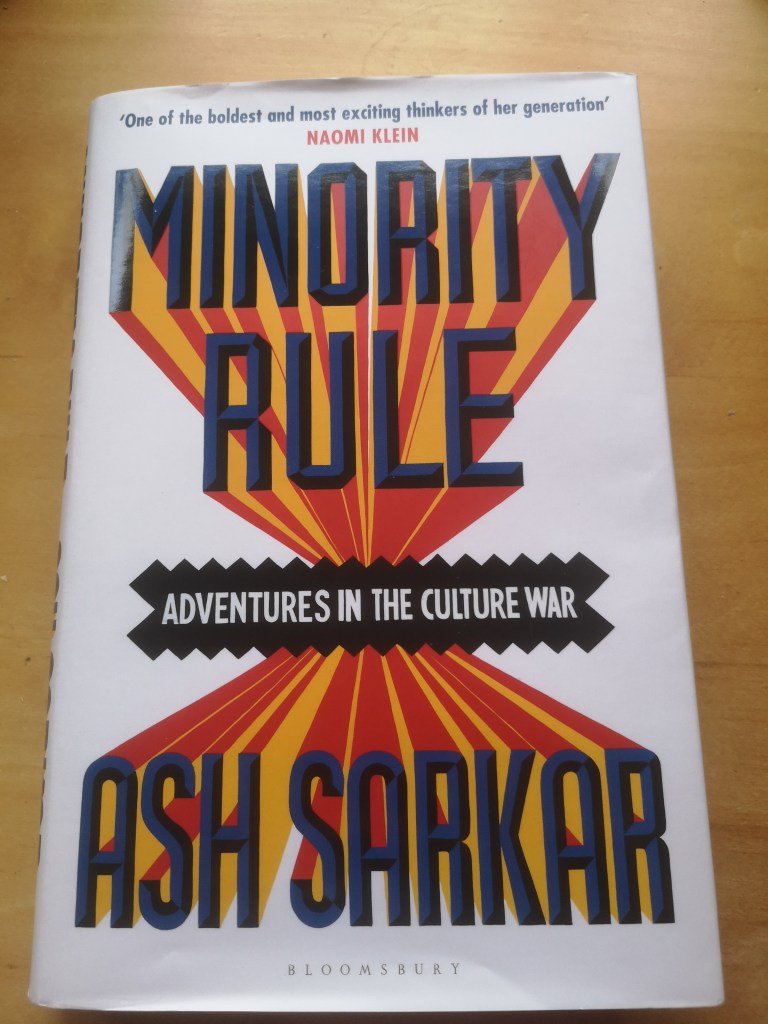
Fortunately, Ash Sarkar clearly does not imagine that every kind of contemporary anti-racist or feminist politics is yet another expression of neoliberalism. There is no reason to think that she is on the way over to the other side. But, even so, there were moments reading (the incredibly badly titled) Minority Rule when I was reminded of Angela Nagle, who is the cautionary example of such a trajectory given by Richmond and Charnley. For although Sarkar does not argue anything so self-evidently ludicrous as that people posting about alternative gender identities on Tumblr are directly responsible for the Trump ascendancy (the basic thesis of Nagle’s 2017 book, Kill All Normies: Online Culture Wars from 4Chan and Tumblr to Trump and the Alt-Right), she does broadly position herself in the same territory:
I’m going to examine how the weaknesses in progressive arguments about identity politics helped set up the trap created by the right in their mobilisation of the Minority Game [. . .] You’ll see how scaremongering about Minority Rule has created the conditions for an authoritarian power-grab in the UK and America. (20)
There is also a section in which she discusses some ‘niche controversies’ on twitter and concludes that arguments about language ‘have made liberal identity politics an unwitting accomplice in the right’s backlash against progressive politics’ (50). Later she writes that ‘one of the reasons that it’s not so easy to dismiss this relentlessly negative depiction of the left in the media is that many people have direct experience of getting drawn into hostile debates on social media’ (99). Really? The number of people who get drawn into the replies and comments is a subset of the subset of the population who use social media and Sarkar only discusses twitter in any case. Most people’s vague understanding of twitter comes from selective reporting in legacy media. To get distracted by this stuff – the replies and comments – is to get distracted by what Richmond and Charnley characterise as neoliberal anti-identity politics.
If there’s an overall intended historical thesis to Minority Rule, it’s that the right has taken advantage of identity politics ‘to destroy and enfeeble the engines of class consciousness, which tied people’s sense of social identity to their material conditions’ (143). However, what Sarker shows in practice is not the right reacting to supposedly liberal identity politics but the right increasing pursuing an agenda of authoritarian populism in the face of social change and leftwing attempts to build a collective and inclusive alternative. In other words, Minority Rule offers a profoundly mixed message. It seems to be addressed simultaneously to two different audiences: the post-2008 left and the wider public who watch the kind of mainstream news shows that Sarkar appears on (and who presumably form part of the intended market for this mainstream book). There’s slippage between exposing the way the right highlight fears of marginalised minorities to distract us (the public at large) from the massive economic inequality which pervades today’s Britain, and exposing our (the post-2010 left’s) complicity with identity politics in order to seek approval from … well, from what theorists might term the ‘Big Other’ (some collective embodiment of the card-carrying class-conscious capital-L ‘Left’). At the same time, much of Sarkar’s most effective analysis highlights the assault of the rightwing governments of the past 15 years on trans people, asylum seekers and refugees, workers and young people more generally. In other words, the book is above all an extended piece of leftwing journalism. Reviewers have picked up on these mixed messages. Thus, the review in Tribune by Rebecca Alexander highlights the general message for the wider public: ‘Instead of pursuing a common goal — dismantling the structures that sustain inequality — we have been conditioned into fearing the wrong kind of minority (i.e., the marginalised rather than the wealthy). If we are made to fight among ourselves, so the theory goes, they can get away with more’. But also acknowledges both its journalistic nature and exhortatory message to the left: ‘In the final instance, Minority Rule is more diagnostic than prescriptive [… ] she has at least done a great job of trying to steer the left back in the right direction, and — just maybe — pick up some new comrades along the way’. The review also commends Sarkar on her ‘humility’ and ‘self-awareness’ in confessing that she ‘got Brexit wrong’, which, as we’ll see, is not actually quite what she does. Nevertheless, I think this review probably gives an accurate indication of the response that Sarkar was aiming for. However, I also think that if this is the case, she is doing a disservice to herself. For all its faults, the book deserves to be seen as something more than a contrite account of the importance of returning to the fold. At the very least, it illustrates some of the ways that the left is tying itself in knots over anti-identity politics and the culture war. Therefore, I provide a more detailed and extensive analysis below.
What is to Be Done?
Towards the end of Minority Rule, Sarkar writes:
Anti-trans hostility, the Great Replacement and attacks on abortion rights are all part of the same demographic panic. It’s all about controlling who gets to determine the composition of the nation. By claiming that the increase in openly transgender people is the result of ‘social contagion’ (rather than, you know, society being a bit less queerphobic than it used to be), it opens up an avenue for state control of people’s bodily autonomy. You can’t let one person be trans in peace, lest it leads to dozens more. And if your overriding priority is to boost the population of the white breeding stock, of course you’ll clamp down on reproductive freedoms and turn back the clock on LGBTQ rights. Because unless people’s ability to live their lives in the way of their own choosing is drastically reined in, who knows what kind of nation they’ll produce? Ethnic diversity will increase inexorably, and the dominant group, whether it’s white people in Europe and America or Hindus in India, will cease to enjoy the advantage of numerical superiority. Racism, however, has never been a simple numbers game. Whether it’s the apartheid regime of South Africa or Israel’s control of the West Bank and illegal settlement construction, some societies have chosen forms of de jure minority rule over multi-racial society. Such nations define themselves by supremacist ideology – and implement ever more authoritarian means in order to uphold it. That’s the choice facing societies across the world: embracing multi-racial democracy, or the myth of identitarian supremacy. (243-4)
Reading this, you’d assume that the overall argument of the book is for an intersectional socialism in which different struggles are linked and shown to be part of one bigger struggle against capitalism and the capitalist ruling class. In fact, much of Minority Rule does broadly correspond to that position. However, this is not the case with the introduction, the first chapter, the concluding epilogue and the way that the book is framed overall. In these sections, the message is that:
… something at the very core of us has been transformed by decades of rentier capitalism and ideological neoliberalism. We’ve lost faith in our ability to change things. We’ve come to doubt the value of working with people who don’t perfectly resemble us. We’re suspicious and punitive, building barriers and tripwires to confirm that other people are not to be trusted. We make sameness the condition of solidarity. This pervasive feeling of woundedness and wariness is a product of the left’s historic defeats over the past forty years – we’re like this, because we’ve been losing. But it’s also time to admit that we’ve been losing because we’re like this. We can’t achieve anything while minoritising ourselves.
This doesn’t mean throwing away identity-based struggle and ignoring the brutal injustices of racism, sexism, ableism, homophobia and transphobia. But if we continue to insist that minorities can fight alone, we’re consigning ourselves to losing alone. We can no longer afford to disappear into the solipsism of feelings; its imperative that we pull our heads out of our arses and refocus on the material harms which exist outside of individual subjectivities. (266)
This carries on a bit longer, telling us not to ‘dedicate ourselves to policing the boundaries of our own moral purity’ and … well, you get the idea. This is the conclusion to the whole book. If you just read this section on its own, you might assume that the book is full of examples of woke snowflakes disappearing up their own individual subjectivity in pursuit of their moral superiority, but it isn’t. Just about the only piece of anecdotal evidence in the book that might be interpreted in that way comes at the beginning of chapter 1, ‘How the “I” took over “Identity Politics”’: ‘It was when the silver-haired climate activist called everyone in the room “a bunch of fucking cunts” that the wheels began to fall off’ (23). This was an October 2023 event in Liverpool bringing the radical left together to discuss ‘What is to be done?’ The result, as Sarkar reports was that people got very upset and were unable to move on to discuss sensible matters such as whether the Labour Party is a useful vehicle to organise in. As the complaints continued, Sarkar reports herself thinking of the fate of activists such as Fred Hampton and Trotsky and concluding ‘if we couldn’t cope with a stern climate activist calling us a bunch of fucking cunts, what hope had we of taking on the state?’ (25). This rather bizarre stream of hyperbole doesn’t distract from the fact that this example is any case not really illustrative of the point being made. For a start, the activist in question was Roger Hallam of Extinction Rebellion, who is a divisive figure even amongst climate campaigners. More importantly, though, is that there is a long socialist history of organising public meetings and events according to rules and procedures ensuring that meaningful debates take place and collective decisions can be worked out. One of those rules is generally that speakers are not gratuitously offensive to the audience for precisely the reasons demonstrated by this example. Therefore, my socialist analysis of the problem (from the information provided here) is that there weren’t effective guidelines in place for the event. Sarkar’s analysis, however, is that this is a typical example of the left ‘immobilising itself over matters of identity’ (26). Likewise, she provides some examples of twitter storms later in the chapter that I agree are fairly ridiculous but don’t see as somehow explaining the left’s inability to mobilise in the ongoing political crisis of recent years.
Identity Politics
Sarkar notes that she is aware that some of her friends are going to be annoyed that she is writing this but insists that ‘because we’ve embraced a version of identity politics in which individual experiences trump collective realities, the right has been able to appropriate it as a weapon for their own ends’ (26). Now, this sentence does a lot of work in carrying the freight of the overall argument of the book, which seems to be that all the right-wing culture war attacks she writes about in chapters 2-7 were ultimately enabled by the left absorbing the tenets of liberal identity politics and becoming obsessed with moral purity rather than collective action.
Sarkar’s historical argument is that identity politics originated with The Combahee River Collective Statement published in 1977 and was originally ‘unambiguously anti-capitalist, collective, and international in its scope’ (31). However, over time the concept has become detached from a clear sense of material priorities and ‘become a largely middle-class preoccupation, due to its spread in elite universities … in the competitive yakkety-yak of arts and humanities seminars’ (46). In this way, and through its spread to the media, we are told that identity politics has become ‘the master-frame through which political conflict is understood’ (59). In response, however, the reactionary right has managed successfully to represent this form of identity politics as solely a means of legitimating and advancing the cause of women, queer people, racial and gender minorities over that of the ‘silent, censored, forgotten or abandoned majority who are under attack by minority causes’ (59).
There are several problems with this account presented by Sarkar. Apart from anything else, it simply doesn’t work historically because the right was deploying the trope of the silent/hidden majority long before the term ‘identity politics’ had been coined. For example, Nixon was using it in the 1960s, but the idea has been employed implicitly by authoritarian populists since at least the nineteenth century: it wasn’t indirectly enabled by the post-1989 expansion of the UK HE sector and too much ‘yakking’ in English Lit seminars. The biggest problem with the book, though, is that the title, Minority Rule, aligns it directly with the reactionary myth propagated by culture warriors such as David Goodhart and Matthew Goodwin that the UK is really ruled by a minority metropolitan elite trying to impose liberal diversity on the Great British public. Sarkar is perfectly aware of this and indeed defines ‘Minority Rule’ in her introduction as ‘the paranoid fear that identity minorities and progressives are conniving to oppress majority populations’ (11). Her justification for using this title nonetheless is that she is exposing how the real elites ‘(as in, the real ruling minority of hedge-fund managers, press barons, landlords, corporations and oligarchs)’ use Minority Rule as cover for their authoritarian and antidemocratic activities, while playing minorities off against each other. In other words, the book’s justification is that it will show us ‘how the paranoid fantasy of Minority Rule upholds a real minority rule, by keeping us divided and competing against one another for attention’ (20). The trouble with this is that there is just too much slippage between the terminology. By describing the right’s characterisation of identity politics in the way she does, Sarkar effectively endorses it. The approving reader of Goodhart or Goodwin will be nodding their head along with most of this too. The rightwing press has the option of using it as fuel for its usual ranting, as demonstrated by these Telegraph articles, ‘The Queen of woke just exposed the hypocrisy of the virtue-signalling Left’ and ‘Even a “literal communist” like Ash Sarkar knows the Left is in crisis’, or slating it as in The Sunday Times’ dismissal of it as a ‘misery memoir’.
My impression from reading the book is that Sarkar hasn’t internalised the right’s arguments directly but more likely indirectly via criticisms made by sections of the left and old left. There’s a telling confession later on in which she admits to feeling ‘a horrible sense of personal responsibility’ for the outcome of the 2019 General Election:
I wrote articles arguing that Labour should take more of a pro-EU stance than a pro-Brexit one. I lobbied hard on things like more ambitious climate commitments, ending immigration detention and adopting universal basic income. I forget the number one rule in politics: learn how to count. Because there were far more people in the country who weren’t like me than those who were. As I trudged around news studios after the exit poll came out … I could feel a narrative emerging around me. Metropolitan elites like me had lost the working class. (135)
In this respect, the book can be seen as an extended apology and public penance. Obviously, many people felt depressed after the 2019 election. I don’t want to downplay that reaction (I can remember how absolutely awful I felt after both the 1987 and 1992 elections, absolutely devastated). However, there really are pitfalls in letting the electoral cycle of party politics impact on your thinking. Despite the absolute victory for Johnson’s Tories in that election, we know that the result was decided at most by a few hundred thousand voters across 30-40 constituencies. It wasn’t a landslide however much the mainstream media presented it that way (similarly, Trump’s 2024 election victory was not a landslide or even big win: he still took less than 50% of the vote). There were not actually far more people in the country who didn’t agree with Sarkar’s 2019 political positions than did agree with her. In other words, there is no need to apologise!
Cultural Materialism
Nevertheless, Sarkar also apologises, on behalf of the twenty-first-century left, for ‘chuck[ing] the idea of material truth out of the window’ (28), which she equates with the abandonment of the idea that we all live in a shared reality. We need to return to good old-fashioned twentieth-century materialism:
Materialism is the idea that it’s real-world conditions that shape consciousness and not the other way around: so if you want to understand a person, or a whole community of people, you should look at the distribution of wealth, resources and access to power. (27)
This comes close to a crude Marxist analysis of false consciousness. Ok, this isn’t a theoretical work and no doubt there were editorial pressures on Sarkar shaping what she could write. But, even so, this is a simplistic take on a complex issue. By coincidence, the latest issue of New Left Review came through my letterbox while I was writing this review and it includes an article by Perry Anderson touching directly on these kinds of arguments by examining whether ideas ‘are mere mental epiphenomena of much profounder material and social processes, or do they possess a decisive autonomous power as forces of political mobilization?’ Anderson argues that ‘those [ideas] which are relevant to major historical change have typically been systematic ideologies’, but within a few lines he develops this formulation by suggesting that what is meant by ‘systematic ideologies’ can be readily substituted by culture as conceived by T.S. Eliot (or, I would like to add, by Raymond Williams). In this respect, it is conceivable to think of a ‘culture war’ that would function in the manner of a clash between systematic ideologies and have genuine historical (and material) consequences. Now, I am well aware that this is not generally how the term ‘culture war’ is understood by the media or by Sarkar, but I think we’d be well advised to keep this (hard, if you like) version at the back of our minds.
Anderson goes on to conclude that history shows ‘that ideas count in the balance of political action and the outcome of historical change’:
In all three of the great cases of modern ideological impact, the pattern was the same. Enlightenment, Marxism, Neoliberalism: in each case a system of ideas was developed, to a high degree of sophistication, in conditions of initial isolation from, and tension with, the surrounding political environment – with little or no hope of immediate influence. It was only when a major objective crisis, for which it was in no way responsible, broke out, that subjective intellectual resources, gradually accumulating in the margins of becalmed conditions, suddenly acquired overwhelming force as mobilizing ideologies with a direct grip on the course of events. Such was the pattern in the 1790s, the 1910s, the 1980s. The more radical and intransigent the body of ideas, the more sweeping its effect, once unleashed in turbulent conditions. Today we are still in a situation where a single dominant ideology [i.e. neoliberalism] rules the greatest part of the world. Resistance and dissent are far from dead, but they continue to lack systematic, uncompromising articulation. None will come, experience suggests, from feeble adjustment or euphemistic accommodation to the existing order of things. What is needed instead, and will not arrive overnight, is an entirely different spirit – an unflinching and where necessary caustic analysis of the world as it is, without concession to the arrogant claims of the Right, the conformist myths of the Centre, or the bien-pensant pieties of too much of what passes for the Left. Ideas incapable of shocking the world are incapable of shaking it.
The admonition to those passing for the left no doubt applies to me, but nonetheless I accept the diagnosis that we are in a global battle to establish a new mobilizing ideology. I would argue that this battle is exactly what characterises the bigger, deeper Culture War, underlying the smaller pettier ones that Sarkar and the media in general focus on. One of the bones of contention is ‘liberalism’. This is a term that nowadays has many different meanings. When Sarkar talks about a turn to ‘liberal’ identity politics, she’s not referring to either Liberal Democrats or nineteenth-century ‘Classical Liberals’. Rather, she is using ‘liberal’ in the denigratory sense popular amongst sections of the left in the UK and US, where it stands for people who are not ‘us’ but not conservatives either, with the implication being that such ‘liberals’ have internalised neoliberalism. However, there is another loose sense in which pretty much everyone from Jeremy Corbyn to Boris Johnson, including both Ash Sarkar and myself, is ‘liberal’, which is that we all embody post-Enlightenment ‘individual subjectivity’ – to employ a term that, as we have seen, is used by Sarkar. We’re not going to build a more equal, collective, intersectional and intersubjective society by talking tough about ‘materialism’ – or describing it as a ‘scientific method’ (27) – and pretending that we don’t have this individual subjectivity. Meanwhile the right is starting to coalesce around a programme of ‘ending’ liberalism and becoming ‘sovereign individuals’, while dismissing individual subjectivity as a ‘luxury belief’. Admittedly, for all the right’s talk of the failure of liberalism, theirs is also self-evidently a post-liberal project – but then, the right isn’t hindered by requiring a rationally coherent intellectual position to be the foundation of its systematic ideology. The left is always under a disadvantage in this respect.
So, if the above is something like the state of the current struggle of ideas between the right and left, the question is how does Minority Rule help the cause of the latter? The answer is that because of the framing at the beginning and end of the book, and the fact that this framing in entrenched through the choice of title, it doesn’t help much and is most likely a hindrance (although, as I’ve said, much of the rest of the content is on the whole better than the framing).
Culture War
Apart from anything else, the trouble with arguing that we should pay more attention to economic relationships, is that economic explanations also function ideologically, especially in the UK. For example, the limitation of framing British politics through the lens of ‘austerity’ is that we are actually distracted from the cultural and ideological consequences of government actions. In the US, the DOGE attacks on government programmes, accompanied by Elon Musk’s performative chainsaw wielding, are being seen for what they are: a systematic attack on the sociological systems – education, welfare etc – that make up a functioning state. The New York Times is currently full of articles bemoaning ‘The End of the University as We Know It’ and the fact that Academia is ‘Facing a Campaign of Annihilation’. In other words, in the US there is actually public discourse surrounding what is actually happening. The same things are happening in the UK, but because everything is being portrayed in terms of the needs for public spending cuts and the costs of rearmament, there is an almost comical indifference to the wholesale destruction of the social and cultural order. A Labour Government, some of whose ministers intervened to bail out the banks in 2008, are perfectly happy to sit back and watch the UK HE sector completely implode on their watch. Keir Starmer can blithely talk of decimating public service and replacing it with AI with virtually no consequence. It’s precisely because of a British fetishisation of the (narrowly-defined) ‘economic’, that we have no defence against the all-out cultural assault currently being waged upon us by a political party that even today some people (although not many to be fair) still see as a ‘class party’. Ok, as Sarkar points out, the British press don’t focus on the unremitting process – originating in the 1980s but in full flow since 2010 – by which neoliberal outsourcing siphons public wealth more-or-less directly into offshore tax havens (the main reason the UK economy has been stagnant since the financial crisis). But even if they did, it would still be viewed in economic terms – I’m not sure it would help immediately in the explanation of what is actually happening to us.
In Britain you have to go back pretty much to the time of Raymond Williams to find a period when the left last had the cultural and political tools to explain what was at stake in British society. Tellingly, Sarkar has to engage in the speculative fiction of imagining what it would be like if air was privatised to try and explain what has happened to us over the last 15 years or so (see 245-7). This is reasonably effective, but it doesn’t capture the brutal, unprecedented cultural impoverishment (by cultural, I mean in Williams’s sense of ‘a whole way of life’, not ‘high culture’) that has been the real hallmark of these years. Rather than demonstrating, as Sarkar suggests, the consequences of the left internalising ‘an individualistic and competitive model of victimhood’ (248), her analogy exposes the limitations on political analysis that result from the left losing track of the fact that culture is also material and politics are therefore always inherently cultural as much as they are economic.
If Minority Rule had a different title and a different framing, it would be easier to read the later chapters as intersectional left critiques of right-wing culture attacks which are seen for what they are, rather than as indirect evidence of the guilt of ‘identity politics’ in initially legitimating a politics of grievance which the right have been able to appropriate. However, even here it is necessary to present a certain narrative of a class-conscious (working class) country being split by identity politics in order to construct a majority for the right. This requires a somewhat dewy-eyed account of 1945-1979 postwar Britain when ‘working-class people voted labour as a bloc’ (144). It should be said that not all of them did and furthermore that at least the last decade of that period was characterised by sharp social division. Sarkar interviewed Dominic Cummings – the only other person she interviews in the book is Piers Morgan – to be told that Vote Leave believed there is a socially conservative majority in Britain and that immigration, especially of refugees and asylum seekers, was the touchstone issue to weld a combination of Conservative and Labour voters into a majority for Brexit. She rightly points out that Cummings frames this process as though ‘anti-immigration policy sentiment is a natural response to our “out of whack” immigration policy’ (151). Then, in one of the best sections of the book, she moves from a personal anecdote about how ‘asylum seeker’ was used as an insult at her primary school in Enfield, via a discussion of the Sun’s coverage of immigration and asylum issues, to a discussion of Tony Blair and New Labour’s close complicity with the Murdoch Press at this time – to the extent of coordinating policy announcements with a week-long campaign by the Sun on the supposed ‘immigration crisis’. In particular, Sarkar notes the significance of the fact that, between 1997 and 2007, ‘Blair’s government passed five pieces of legislation which made life more difficult for immigration, asylum seekers and refugees’ (157). The result is a powerful analysis of how ‘press and political collusion’ created a moral panic – so not a ‘natural response’ – that was a means of splitting ‘the British working class along the lines of race and migration’ (160).
This analysis is followed up in the next chapter with a detailed account of how the demonised chavs of the early 2000s became magically transformed after 2010 into the honest hard-working white working class with their legitimate concerns. The House of Commons Education Committee even produced a report in 2021, ‘The Forgotten: how White working-class pupils have been let down, and how to change it’. This, as Sarkar notes, features an extensive discussion of the term ‘white privilege’ without providing any evidence that it had ever been used or in any way employed in an educational context. In the same year, the report of the Commission on Race and Ethnic Disparities, the Sewell report, ‘argued that Britain “no longer” has a system rigged against people from ethnic minorities’ (200). She is absolutely correct to argue that these two reports ‘operated as a one-two punch’ timed to coincide with a period when the Black Lives Matter movement was top of the news agenda (201). Such approaches form the essence of the authoritarian populist tactics in the culture war because they combine the force of official diktat with providing supposedly reputable textual resources which can be quoted and used as ‘impartial evidence’ for policy making in the UK and elsewhere.
Therefore, these later chapters do contain the type of content and analysis that we might expect in a book by a left-wing commentator – although, we might also expect claims, such as that of Cummings, that the majority of the British public are socially conservative to be questioned and put under pressure. There is some discussion of this point in connection to Sarkar’s interactions with Piers Morgan. Morgan insists to her that he ‘reflect[s] probably the majority of people’s views’ (71). The immediate context is the preamble to a 2022 episode of Piers Morgan Uncensored on the topic of ‘what is a woman?’ Sarkar points out, drawing on YouGov polling from that year, that people don’t have a blanket view on trans issues:
Most people will take pro-trans positions some of the time, and more trans-hostile positions at other times. On the specific issue currently agitating Piers Morgan – transgender women participating in women’s sports – his view is in line with public opinion. But that very same public opinion has been profoundly impacted by the tenor and intensity of how the media has covered that issue. (71)
Indeed, it’s not a neutral process. And neither is Yougov’s polling on the topic, which is part of a longitudinal series they are running over time to show how social attitudes change. The latest instalment, conducted mid-December 2024, has recently been published and is headlined as showing increasing scepticism towards trans rights. The unwritten subtext is that this in Cummings-speak is a ‘natural process’ illustrating social conservatism – the 2025 YouGov article lists the following developments in its opening paragraphs:
Donald Trump’s first acts upon resuming the presidency have been to sign executive orders declaring there to be only two sexes, restricting gender care services for young transgender people, barring transgender people from military service, and banning transgender women from women’s sports.
Here in the UK, the 2024 general election saw the Conservatives pledge to change the Equality Act to rewrite the definition of sex and allow organisations to bar transgender women from single-sex spaces, and that the concept of gender identity would not be taught to children. The increasingly popular Reform UK has criticised transgender “indoctrination” and promised to “ban transgender ideology in primary and secondary schools”.
On one level, none of this – especially Trump’s activities – is directly relevant to British social attitudes. However, in the same way as Sarkar demonstrates so effectively regarding British attitudes to asylum and immigration, public opinion with respect to trans people is being driven by ‘press and political collusion’. Rather as Blair’s government repeatedly passed legislation targeted at refugees and asylum seekers, the Tory governments since 2016 have used executive power to attack trans people. For example, in 2023 the Sunak government issued draft guidance to schools on ‘gender-questioning children’ which was clearly intended to try and stop students transitioning at school. The coverage from the Guardian/Observer demonstrates how the ‘collusion’ process works. The Guardian news report, ‘Schools in England will not have to flag pupils asking about gender’, ignored the harm these recommendations would cause to trans students and tried to present the report as a reasonable compromise: ‘Schools will be expected to inform parents if children tell staff that they want to take any steps towards transitioning, but they will not have to flag conversations if children are just asking general questions, or in the event of safeguarding issues’. The tone completely belies the fact that this is a totalitarian government intervention within the public education system of the kind which the Guardian of a few years earlier would have had no hesitation in calling out in Putin’s Russia, for example. (Indeed, this article by Pippa Crerar, the Guardian’s political editor, is an indirect example of Sarkar’s criticisms in Minority Rule of the way that lobby journalism works – it’s basically a press release with a none-too-subtle hint that Tory politicians would really have liked to go much further).
A few days later, the Observer’s editorial, ‘Schools guidance on gender identity could help us move on from this toxic debate’, made little effort to conceal its transphobia, welcoming the government’s guidance as ‘an important first step’ and going on also to quote the interim report of the Cass Review uncritically as evidence ‘that gender dysphoria often naturally resolves itself through puberty’. Sarkar later mentions the Cass Review but recuse herself from discussing it in depth on the grounds that she’s ‘not a doctor’ (219). However, its function is exactly the same as the ‘Forgotten white working class’ and Sewell reports: to be deployed by the authoritarian right here and elsewhere (notably in the US) as ‘evidence’ to support draconian authoritarian measures. Indeed, the Observer editorial above is a perfect example in miniature of the authoritarian nexus of press, government and specially compiled ‘evidence’ that has become a key modus operandi of the rightwing culture war. A similar collusion between press, government and the law surrounded the outrageous misuse on 17 January 2023 of a Section 35 order by the Secretary of State for Scotland to block the 2022 Gender Recognition Reform (Scotland) Bill. One particular effect of these kinds of executive action – which are not democratic decisions, they haven’t been through Parliament but are simply enacted by government ministers – is that they give sections of the public the idea that trans people are doing something wrong and illegal. So, the apparent trends in public opinion we see, as polled by YouGov, are not ‘natural processes’ but the result of deliberate social engineering imposed by the combined effort of the press and government. The exact same authoritarian populist culture-war tactic of repressive legislation and relentless press coverage was used by the rightwing Thatcher government in the 1980s to attack lesbian and gay rights. In the late 1980s, this did for a while suppress public opinion in favour of lesbian and gay rights. However, despite the retention of the specifically homophobic Section 28 legislation of 1988 until the second term of the Blair government, the tide of public opinion switched in the 1990s as soon as government focus on the issue dropped. One of the lessons of that experience is that it requires an intense, time-consuming effort from government and press to manipulate public opinion in this way. As soon as the current coordinated transphobic onslaught of the press and government starts to fade, we can expect to see significant reversals of the supposed trend of public opinion towards scepticism concerning trans rights (although it should be noted in any case that according to the 2023 British Social Attitudes Survey, the majority of the public still remain ‘not prejudiced at all’ against trans people despite the concerted efforts of press and government).
Sarkar points out that surveys repeatedly show that the vast majority of the public don’t think that discussions around trans people are one of the most important issues facing the country and concludes that from the media’s perspective: ‘It doesn’t matter whether or not people think the content you’re producing is important – the key thing is that keep consuming it’ (74). There are two implications being made here. First, in connection to an argument she has made earlier in the book with respect to media platforms, that ‘our attention is the commodity. The content is just the lure’ (60), she is implying that specific nature of transgender existence is not important to the media – something else contentious like vegan sausage rolls might do just as well – and that this is just about monetising our attention. Second, that the topic is chosen entirely for the purpose of generating a polarised debate which is therefore more likely to distract people’s attention from more complicated economic processes – such as outsourcing – and split the working class. Now, there’s some truth in both of these, but they are not the primary purpose of the media coverage of trans issues (anymore than the commodification of attention and distraction, though undoubted outcomes, were the main purpose of the media focusing a few years ago on the accusations of antisemitism against Corbyn). As Sarkar, herself, concludes in yet another discussion later in the book: ‘What are trans people meant to do, if there’s no way for them to be socially recognised as their chosen gender in public life? Never leave the house? Evaporate?’ (218). Well, yes, exactly! The main purpose of continued assault by press and government on trans people is to destroy public support for them and then outlaw their existence as the first part of a reactionary, authoritarian agenda. Trump and the forces behind him are currently in the process of enacting this for real. As explained in this New York Times article by a trans columnist (a category whose existence Sarkar questions), ‘The Hidden Motive Behind Trump’s Attack on Trans People’, the point is to ‘denationalize’ whole groups of people.
In conclusion, Minority Rule is a confused book with a deeply problematic title and a weak central thesis. However, the later chapters include some more effective analysis. Sarkar writes engagingly and the anecdotes she tells mostly fit nicely with the points she is trying to make, but the book remains bound up in neoliberal anti-identity politics and a no-culture-war-we’re-British attitude. The left’s rejection of identity politics is often framed as a clash between universal and particular principles. For example, Richmond and Charnley quote Eric Hobsbawm arguing in the 1990s that ‘identity politics assumes that one among the many identities we all have is the one that determines or at least dominates our politics … and of course that you have to get rid of the others’ and further suggesting that this leaves the left ‘without any obvious way of formulating a common interest across sectional boundaries’. However, Hobsbawm’s position is entirely dependent on assuming that identities are fixed, essentialist and mutually exclusive. In the twenty-first century, our concept of identity tends to be more fluid, plural and overlapping. At the same time, Hobsbawm’s position also depends on some sort of notion of a fixed universal, class-conscious identity, characterised by no individual subjectivity beyond a fictional race- and gender-neutral collective position. This has never actually existed anywhere outside socialist-realist film and fiction (and, in fact, most proletarian literature does not simply document but draws on a range of styles, including avant-garde and modernist techniques, to represent class consciousness as a complex, fluid and plural interplay of identities – I’ve written a book about this). Therefore, the apparently leftwing idea that Sarkar gamely tries to sell to us, of abjuring the siren call of identity politics and returning to the golden age of ‘class consciousness’, ‘materialism’ and supposedly ‘scientific method’, is at best a massive red herring. Class consciousness is not something that is achieved by staying ideologically pure. To the extent that it’s a useful concept, it’s attained in practice through the various forms of political struggle against the authoritarianism of the capitalist ruling class. The idea that there is some sort of short cut whereby if we all thought the correct way then we’d already be several drinks in at the eternal bar of communist utopia is exactly the kind of subjectivity-determining-materialist-reality wish fulfilment that Sarkar wags her finger over. So, the real moral of this story is that the left should ditch the rhetoric of neoliberal anti-identity politics and commit fully to a more fluid, intersectional politics which would both support minorities and build a society rooted in social and economic justice that would work for all.

