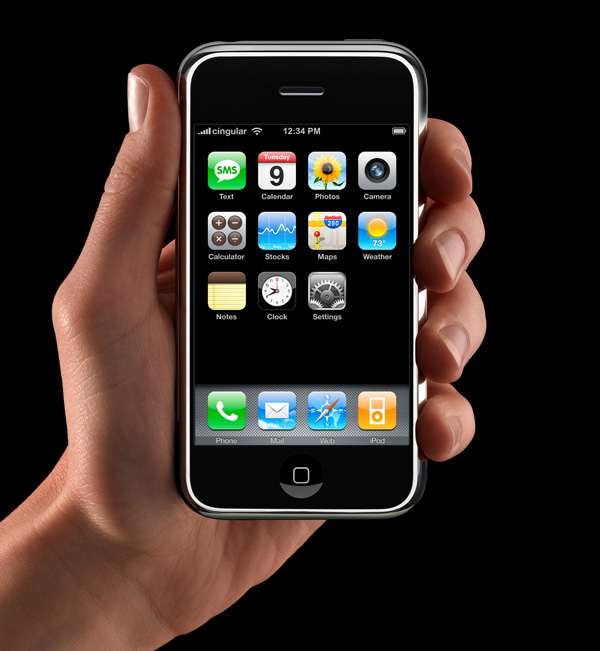
Bad Takes of Our Times #1: The invention of the iPhone is to blame for everything…

I’ve seen the ‘iPhone argument’ argument – that the launch of the first iPhone in 2007 is the point in time when everything started to go ‘wrong’ – once too often over recent months. This particular version in relation to British prime ministers has been on the radio and on Facebook etc as well as in this FT article:

One ally [of Keir Starmer] said: “There have been seven prime ministers since the iPhone was invented and seven in the 42 years before that. Everywhere around the world there are unpopular incumbents but of course we want to do things that are popular. That’s why 2026 will be the year when renewal becomes a reality.”  – ‘There’s a real dislike, even loathing’: why voters hate Starmer and Reeves, Financial Times, 31 December 2025.

The argument being made here – that social media is to blame for the short-term swings of public opinion but that Labour can restore stability in 2026 – is obviously nonsense but, at the same time, it’s also a good example of how the iPhone argument is deployed.

There are some obvious factual objections to this argument. First, between 1955 and 1964, there were five prime ministers (Churchill, Eden, Macmillan, Douglas-Home, Wilson), so rapid turnover is not an unprecedented historical phenomenon. Second, if we wanted to make 2007 the significant point in modern history, it would make more sense to refer to the beginning of the global financial crisis rather than the launch of the iPhone. Third, the current instability and rapid turnover in British politics owes a lot to 2016’s Brexit.

While social media has exacerbated some of these tendencies, it’s not clear that this is always due to the smart phone. Many political changes have arguably been driven by older voters. While targeted Facebook advertising and closed groups plays a role, this might be accessed through PCs or laptops. In other words, the iPhone argument is being deployed in this instance as a distraction. The short-term intent of the above quote is to distract us from how unpopular the current Labour government is for long enough to make the preposterous claim that all this will change in 2026. It won’t.

The deeper intention is to distract from a wider dissatisfaction with the UK political system, which dates back long before the current century. For example, the last UK General Election to attract a turnout of over 70% was in 1997 and even then, nearly a million people voted for UKIP or the Referendum Party. The old two-party system has since collapsed. In 2024, the turnout was under 60% and the combined vote of the Tories and Labour was only 3 million more than Labour alone attracted in 1997. This paradigm shift has nothing to do with smart phones and social media. It’s a product of changed cultural consciousness since the 1960s (and earlier). People of my generation and younger, who grew up seeing in colour, are not going to be content with a black-and-white binary political system. There’s no way back to that postwar British system.

The attempt to attribute wider cultural change to post-2007 smart phones is always an attempt to pretend that deep-lying long-term social and cultural processes are merely short-term tendencies that can be easily reversed. The people behind this argument know full well that this isn’t the case but they push it because they want to influence not only public opinion but also sections of the establishment, such as the leadership of the Labour party and the senior management of the BBC. The aim is to prepare the ground for reactionary and authoritarian legislation.

AFAIK, the ‘iPhone argument’ originates with – or at least was massively popularised by – Greg Lukianoff and Jonathan Haidt’s 2018 book, The Coddling of the American Mind where it is used to other Gen Z (12/-)

Lukianoff and Haidt more-or-less argue that cancel culture, safe spaces, gender pronouns etc were all created overnight due to the pernicious effects of the smart phone and social media. They see it, in effect, as a generational mental illness. In my own experience, though, concerns about the content of books and films in teaching long predates this period, I certainly had discussions with students about such concerns over the course of my teaching career from the late 1990s onwards (which were always reasonable and resolvable by mutual agreement). I think such concerns reflected changing social and cultural values. By the 1990s, some elements of postwar everyday culture were no longer considered acceptable because they were damaging. Instead of societies in which people kept their personal opinions to themselves, we moved in the UK, US and other countries, to societies in which values were publicly contested. The iPhone and social media are part of that story, but they are not the cause.

The changes working through society are not the ephemeral consequences of post-2007 smart phones but the product of deeper, longer processes that are going to have to be worked through. There’s no quick reset to some mythological pre-2007 period of everything being wonderful.

Notes on Social Reality and British Nationalism

In this post, I am just noting a developing trend in the way that articles in the non-right-wing (for want of a better way to phrase it) media are reporting social attitudes as ascertained by polling as reflecting social reality or mainstream opinion. The purpose of this is presumably to get their ‘non-right-wing’ readership to change their attitude in line with this ‘new reality’.

For example, according to Sam Taylor Hill, John Denham and Tariq Modood’s article, ‘Beyond Division “Multicultural Nationalism” and the White Working-Class’ in the September 2025 issue of Byline Times (I should note that this article was out-of-step with the generally progressive values of the rest of this issue):

… the disadvantages of economic decline in former industrial and coastal communities, poor social mobility, educational under-achievement, poor health, and the lack of voice and influence found in many white working-class communities sets their lives far apart from politically confident white graduate professionals or the more successful parts of minority communities. This is often felt as a sense of loss of their part in a nation to which they were once central. It can be expressed as resentment if others – minorities or newcomers – are perceived as getting priority, attention, and higher status. These white working-class communities feel excluded from the sense of privilege that being part of the ‘majority community’ was supposed to confer.

Statistics show little real difference between disadvantages in white and ethnic minority working-class communities. Some argue against even talking about the ‘white working-class’, lest it prevent the expression of unified working-class politics. But this misses the point. Right-wing populists can mobilise sections of the white working-class because it does exist as a social reality. It is marked out by demographics, geography, education, history, values, ideas of nationhood and, often, a physical separation from the lives of those who apparently face similar social problems.

I don’t have space to unpick the huge historical claim being made here. My point is that the purpose of this kind of argument is to invalidate critics of the concept of a ‘white working class’ as ‘missing the point’ and not having a grasp of ‘social reality’. I need to trace the logic of this usage of ‘social reality’, which has some grounding in sociology. For example, I’ve seen the term used to argue that certain facets of nation states are in effect social reality that can’t be altered. So, the implicit argument here is something along the lines of claiming that a ‘white working class’ is a core part of the social reality of Britain as a nation state.  

In similar vein, in an opinion column on immigration for the Financial Times on 28 August 2025, Farage is winning the new battle of Brexit, Robert Shrimsley notes

Even so, the impact of his summer campaign has left centrists warning against dancing to Farage’s tune. They argue that talk of an eruption of protests outside asylum hotels has so far turned out to be mostly only a few hundred people. Above all, liberals urge Keir Starmer to fight back against the dehumanising rhetoric of the right.

For those who recoil from the right’s tactics, these are seductive arguments. Scorn is a comforting reflex. But this is where Brexit memories are instructive because we have seen this movie before. The past decade was a masterclass in how to misread a nation.

For when majorities are telling pollsters that the issue is their main concern, the battle has to be fought where it is, not where you wish it to be. Like it or not, the belief that mass immigration has gone too far, that control has been lost and that integration is failing is now a mainstream opinion. 

Shrimsley’s scorn is clearly directed at ‘liberals’ (a pretty meaningless phrase in the context of British politics, but one that has been borrowed from the US) for failing to realise that ‘mainstream opinion’ has shifted. It’s not clear to me why that was already obvious from Brexit given that one of the distinctive features of that experience was how evenly split the electorate was on the issue. The implication here is something along the lines of a claim that Brexit has altered social reality. On one level, this seems to be confusing changes in behaviour of the mainstream political parties with social reality per se.

It has become commonplace in recent months for UK media commentators to argue that ‘recently, the Overton window – the range of ideas and policies considered politically acceptable – has widened on immigration’ – this is George Eaton writing in the New Statesman this summer. Among a list of examples supporting his claim, Eaton cites Farage’s declaration that the UK is facing ‘societal collapse’, which was backed  by the former Tory cabinet minister and current editor of the Spectator, Michael Gove, but also an unnamed Labour MP calling for an ‘“Immigration Sovereignty Act” that unilaterally reforms articles 3 and 8 of the European Convention on Human Rights’. Eaton also reports that many Labour MPs are in contact with former Prime Minister Tony Blair, who apparently believes that ‘the country wants someone to take it by the scruff of the neck, lead it and shake things up’. This seems to me to be a fair journalistic account of what has been happening, which is that a hard anti-immigration consensus has been forming across the political establishment.

In this context, the pieces in Byline Times and the FT can be seen as attempts to shift sections of the public who read these kinds of papers behind this new political consensus. In some ways, it might be seen as a form of gaslighting in which ‘liberals’ are told that the world doesn’t work the way that they think it does; ‘racism is all in your mind, social reality has changed now, so you need to get in line with mainstream opinion’. So, it’s basically propaganda. However, the way it’s framed in terms of ‘the nation’ and in defence of British values is telling about the ultimate agenda here, which is a fairly explicit form of British nationalism. Although in practice this is often the external expression of English nationalism (as evidenced by the current profusion of English flags alongside the union flag in anti-asylum seeker protests). Tellingly, another recent article in the New Statesman claimed that ‘Politically, at least, Britain is becoming more, not less, like Clacton’. The slip here is that it’s England (outside London and the other big cities) that is becoming superficially more like Clacton, not Britain as a whole.

While this agenda is not new, the current intensification is reaching new levels. This coordinated embrace of a British nationalism as a new social reality is part of a wider international shift towards authoritarian nationalism. I aim to publish more blogposts on this process over the course of this autumn, as part of wider ongoing research.