
I was in Brighton in order to do some research in the Mass Observation Archive at the Keep and so I took advantage of the opportunity and trekked out to Hove Museum in order to see the Mantelpiece Observations exhibition of Richard Slee’s ceramics (until 25 January 2022) and Slee’s selection of a number of Humphry Spender’s late-1930s photographs of Bolton and Blackpool. I’ve put up some photos on twitter and instagram. This exhibition was originally at Bolton Museum and the catalogue includes a very good essay by Curator of Art, Matthew Watson as well as an interview with Slee, conducted by Sonia Solicari.
It’s a great exhibition, well set out in three large rooms on the ground floor of the museum, and definitely worth a visit if you’re in the area. The combined effect of the oversized ceramic objects (clocks, candlesticks, envelopes, matchboxes) on large stylised mantelpiece-like white plinths with Spender’s photos on the walls is brilliantly effective in illustrating the interaction between surrealism and everyday life that lay at the heart of the original Mass Observation movement. As Watson notes, the ‘Mantelpiece Directive’ (asking respondents to describe the objects on their mantelpieces), was the first Mass Observation directive sent out to national panellists in 1937. This ‘gave MO a route into the private life of households’. Watson cites Rachel Hurdley (2006, 2013), on how the mantelpiece automatically confers a certain value on what is displayed there, and Rodney Harrison (2014), on how MO were probably hoping to get an insight on the relationship between taste preferences and social class. Furthermore, as Watson highlights, mantelpieces formed an important part of the MO investigation into how families coped with the process of relocation from the city centre to out-of-town local authority housing estates, which was ongoing during this period. The mantelpiece might combine symbols of a new technological future, such as a radio, alongside nostalgic keepsakes from a Victorian past.
Watson quotes Samuel Hynes (1976) to the effect that ‘nostalgia and apocalyptic apprehension, the sad look back and the depressed look ahead’ were the dominant characteristics of the late 1930s. I wouldn’t entirely agree with Hynes that the future was seen as a matter for depression. The promise of ‘the naked democracy of the swimming pools’ that Orwell describes in The Lion and the Unicorn might have been largely a feature of the more prosperous Midlands and South of England but one of the things that MO undoubtedly achieved in their Worktown study of Bolton was to show the inadequacy of a negative, homogenous depiction of the northern working class as victims of the ‘hungry decade’. There is no doubt that it was a time of acute social change and anxiety as Watson explains: ‘It was a period marked by anxieties about joblessness, economic decline (the slow death of the textile industry in places like Bolton), the rise of fascism and the approach of another catastrophic war in Europe.’ Of course, it is this that interests me from the point of view of my project, Understanding Social Change through Autobiographical Narrative. My focus is on thinking about what people actually wrote for MO as a means of self-reflexively coping with change and anxiety, while simultaneously bringing new cultural values and structures of feeling into being. However, mantelpieces can also be seen as a way of doing this; in a sense they were mini-exhibitions curated by ordinary people.
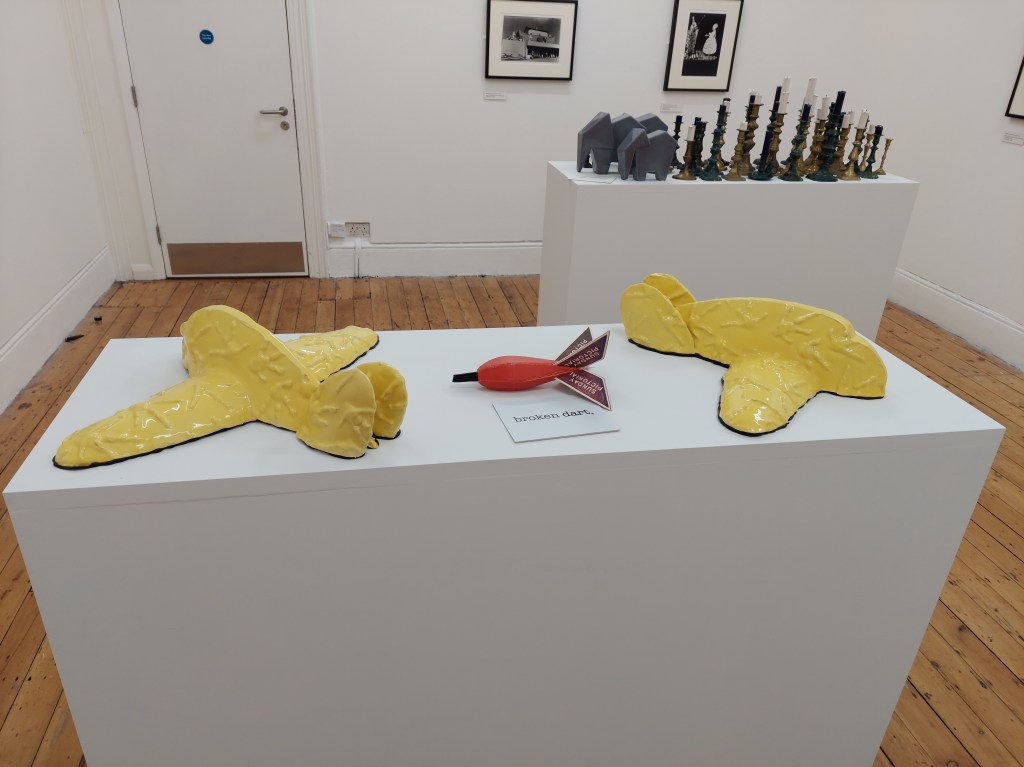
I found it interesting that Slee was determined to avoid nostalgia in his selection of Spender’s photographs (in which he was successful – the signifying effect is very much of modernity, which in itself is indicative of the fact that even in Worktown there was much hope for the future – see also my review of David Hall’s Worktown and my forthcoming post on Hester Barron and Claire Langhamer’s newly-published Class of ’37). In this respect, Slee’s Chicken Air, which turns the chicken feet that boys are playing with in one of Spender’s photographs into yellow ceramic aeroplanes (based on the Lockheed 14 aircraft that brought Chamberlain back from Munich in 1938) is playfully evocative of not only all sorts of hopes and fears, but also of the ceaseless transformations of everyday life itself.
References
Harrison, Rodney (2014) ‘Observing, Collecting and Governing “Ourselves” and “Others”: Mass-Observation’s Fieldwork Assignments’. History and Anthropology, 25:2, 227-245.
Hurdley, Rachel (2006) ‘Dismantling Mantelpieces: Narrating Identities and Materialising Culture in the Home’. Sociology, 40: 717-733.
Hurdley, Rachel (2013) Home, Materiality, Memory and Belonging: Keeping Culture. Basingstoke: Palgrave Macmillan.
Hynes, Samuel (1976) The Auden Generation: Literature and Politics in England in the 1930s. Princeton University Press.

