Q&A on Culture Wars in Britain

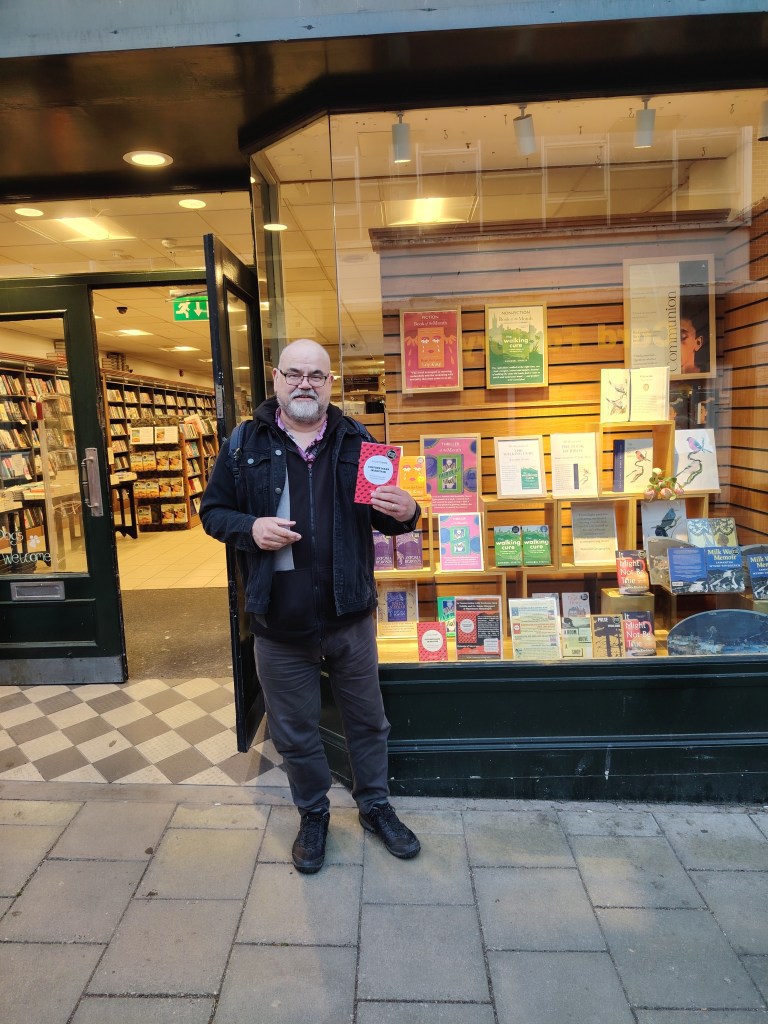
Back in May, I launched my book Culture Wars in Britain at Waterstones in Aberystwyth, where I live. This took the form of a Q&A with Dr Emma Sheppard of Aberystwyth University. This transcript is based on the detailed notes I made in advance and during the event. In several places I have added parenthetical updates on events that have happened since the launch. The book, which costs £16.99, is available to order through bookshops, Amazon and other online retailers, and direct from the publisher at this link (use the code EME30 for a 30% discount).
1. What motivated you to write the book?

As I discuss in the Preface to Culture Wars in Britain, I had been thinking about what causes social and cultural change for some years but then specifically during the Covid lockdown I became fully aware of the false narrative (it’s a conspiracy theory really) that a metropolitan elite had somehow imposed ‘cultural liberalism’ on ‘ordinary people’. At about the same time (2019-2020), repetition of both the phrases ‘culture wars’ and ‘woke’, almost always used in a negative and derogatory sense, began to cut through in mainstream media. So, I thought I need to get to the bottom of this. And that set me to planning a research project and subsequently being awarded a Leverhulme fellowship

And then I realised during 2023-2024, while actually doing the research, that I needed to write a book specifically on culture wars because:

A) Virtually all the books on this theme were being written from the socially conservative side of the argument and it was important to get out the alternative point of view.

B) There were no leftwing arguments on the other side because those on the left were sceptical of the whole idea of culture wars, as indeed many people are. So, therefore, I needed to challenge this scepticism about the idea of culture wars.

Furthermore, it became clear to me from understanding how these cultural dynamics work that I really needed to challenge the idea that we can somehow get back to ‘normal’, where ‘normal’ is imagined to be some sort of centre ground of British commonsense that can be appealed to. This idea that Britain is somehow immune to global trends is ‘the myth of exceptionalism’ referred to in my book’s subtitle. The truth is – as Professor John Curtice has repeatedly stated in recent years while discussing findings from the British Social Attitudes Survey (see, for example, here and here) – that the UK is now split on a culture-war axis between socially liberal and socially conservative blocks which now determine our politics as much as, if not more than, social class. The reason Labour have just lost so badly in the Local Elections (of May 2026) is because they are still under the misapprehension that they can appeal to the country as a whole. In trying to appeal to socially conservative Reform/Tory voters they have alienated their own base, which is overwhelmingly socially liberal, and so as a result their electoral support has fallen through the floor. So, if you want to understand why these things are happening you need to understand culture wars.

2. How important is recognising/understanding the longer arc of history in current culture wars, when it comes to building for the future? Or even in the midst of the everyday?

Culture Wars are a historical phenomenon; they’re not just a recent import from the US. Consequently, all this is not simply going to blow over or disappear in a generation or so. While the use of the term ‘culture wars’ in Britain has only become common since Brexit (although there were earlier usages), I devote a couple of chapters of my book – a chapter-by-chapter description can be found here – to outlining a history of culture wars in Britain dating from before the First World War. 

One of the key arguments of my book is that employing culture wars as a concept to understand society reveals a much wider and more fluid historical process of cultural and social change than is revealed by standard sociological or historical categories. The question that really opened this up for me was the one of how culture wars differ from ‘class wars’. This led me eventually to researching and thinking about war and how it is central to the nation state, which is a hierarchical social structure that originated with the war band. A rigid binary gender divide between male/military and female/civilian is a core component of the social structure and war-making capacity of the nation state. The furious culture wars over gender, which date back even to the nineteenth century, are effectively a struggle over whether we should continue to live in hierarchical, authoritarian nation states.

In Britain, this culture war came to a head in the constitutional crisis that arose in 1910 – a year of two Kings and two General Elections – when the Liberal Government took on the House of Lords, a conflict which led to the Parliament Act of 1911. The eventual consequences of this crisis included Irish independence in 1922, massive trade union activity eventually leading to the General Strike of 1926, and universal suffrage including votes for women partially from 1918 and then on equal terms from 1928. More specifically, the constitutional crisis fractured the Victorian symbolic order and enabled the women’s suffrage movement to rebalance the equilibrium between genders, opening the way for roles for women outside the home. Consequently, women writers, and socialists more generally, gave voice to a new morality and actively sought for new cultural patterns of living. These changes did not just occur in Britain but across Europe, the USA and elsewhere.

However, by the late 1930s it had become clear that Fascist reaction in Germany, Spain and elsewhere was intent on destroying the feminist movement and returning women to the home, as part of a project of restoring the anti-democratic, authoritarian nation state. Even what we think of as the establishment of the Welfare State in postwar Britain was designed to reinstitute a gender binary that had begun to break down in the interwar decades by providing full employment for men and family allowances for women. We can see a historical pattern here that repeats. When that gender binary starts to breakdown, as it has during the interwar years, the 1960s and 1970s, and more recently again in the 2010s, it triggers an authoritarian reflex in defence of the power structures of the nation state. We can trace this authoritarian reflex through the moments when history ‘rhymes’: the Victorian ideal of the ‘Perfect Wife’ who was a ‘biological female’; Thatcher’s attempt to return to Victorian Values in the 1980s by insisting that ‘there’s no such thing as society, only individual men and women’; the UK Supreme Court ruling in 2025 that definitions of ‘man’ and ‘woman’ in the context of the 2010 Equality Act refer to ‘biological sex’. This authoritarian cycle will only end through either some form of apocalypse destroying nation states, or the development of a new, more sophisticated cultural pattern of living enabling the development of post-national social structures.

3. How does the framing of culture wars as American (whether an American problem or driven by Americans) – detract from our understanding and engagement with our own culture wars?

One reason that culture wars are seen as American is that the term first appeared in English in the modern sense in the American media at the end of the 1980s and was then written about by the sociologist James Davison Hunter in his 1991 book, Culture Wars: The Struggle to Define America. Hunter defined the culture wars as an irreconcilable clash between the differing values and worldviews of ‘cultural conservatives’ – those with a commitment to absolute truth and a clear and authoritative set of rules defining acceptable behaviour and our understanding of what is good and evil – and ‘cultural progressives’ – those with a rational and subjective commitment to a relativist conception of truth that is understood as continually unfolding. Rather than argue that politicians cynically use symbols of the culture war for their own ends, Hunter suggested that it’s actually culture wars which establish the parameters of political debate and the positions that politicians can take up within them. Despite this argument, however, British media and politicians have chosen to portray culture wars as cynical distractions and use the American provenance of the term as an excuse to dismiss their relevance to Britain.

Obviously, there are political differences between the US and the UK in terms of areas such as guns, abortion and race, which most British people would consider American obsessions. On the other hand, we have culture wars concerning areas such as the role of the monarchy, the House of Lords and devolution – all of which, as I was discussing earlier, date back at least to the 1910 constitutional crisis. If we concentrate on a particular topic such as abortion, then it seems as if the US and the UK are very different. But if we focus on the underlying struggles between those who wish to uphold culturally conservative fixed values and those who want to live more fluidly and flexibly, then the similarities become more apparent. This means that if we are careful then we can use American analysis to cast light on British culture wars.

For example, the work of the political scientists Ronald Inglehart and Pippa Norris shows how ‘post-materialist’ values concerned with individual free choice and self-expression have spread in the US since the 1960s across successive generations, in conjunction with liberal attitudes to race, gender and sexuality, and fluid social identities that are no longer rooted in faith, family and nation. In their 2019 book, Cultural Backlash: Trump, Brexit and Cultural Populism, they argue a tipping point was reached during the early twenty-first century, when the holders of traditional values, concerning race, gender, sexuality and morality in general, found themselves in the minority, which triggered a violent cultural backlash and authoritarian reflex. As the title of their book implies, this analysis applies equally to the UK and the US.

Attempts to portray culture wars as an unwelcome American import are generally an implicit attempt to reject ‘post-materialist’ fluidity in relation to race, gender and sexuality by socially conservative forces in British politics, such as the traditional right or the old left. There is very little serious attempt to come to terms with the consequences of the social and cultural dynamics identified by social scientists in America such as Hunter, Inglehart and Norris. Most of the British media and politicians are determined to pretend there is a British common culture of ‘ordinary people’, who are defined by a native commonsense and refusal to pay attention to anything other than ‘bread and butter’ issues. This is an incredibly patronising attitude.

What we need to realise is that the fact that Americans have an analysis of what is happening is not the problem. They don’t talk about common culture because they understand that division is real and, therefore, they talk about ways of achieving bipartisanship. They have constitutional checks and balances. We don’t have those things. We have parliamentary sovereignty, which is a pre-democratic system of winner takes all. The real problem is that in Britain we kid ourselves that we’ll be okay because it won’t be as bad as in the US, when it might well end up being much worse because there are no checks and balances and there already is an entrenched hierarchical social system rooted in the monarchy and the House of Lords.

4. Is moral panic always a marker of culture wars?

No, but I think they often manifest that way: everything from single mothers to immigration to asylum seekers and trans people. If you analyse the imaginary threat it does tend to come back to a threat to the gender binary or the social hierarchy of the nation state. A lot of the panic is over the threat to social distinction – the system of privileges that people imagine themselves as being entitled to. As the writer Richard Seymour argues in Disaster Nationalism (2024), politicians such as Trump or Farage use their celebrity status to appeal directly to the many people who have experienced ‘the loss of social distinction’ resulting from the old cultural norms and traditional values and found the experience ‘tantamount to the downfall of civilization’.  For this culturally conservative constituency, the apocalyptic threat of our times is not climate change or the possibility of the Third World War breaking out, but the collapse of what they consider to be the rightful social order. As Seymour says, the panic is caused by the fear that men will become women and that whites will become black.

5. In my own work, gender and dis/ability binaries are threaded through with whiteness – how important is the unspoken nature of whiteness to understanding culture wars?

Whiteness is central to the culture wars. The direct impetus for the intensification of the culture wars in the 2020s and the sustained anti-woke anti-identity politics adopted by the media, publishers and politicians at that time was the Black Lives Matter movement and the enormous wave of street protests in the US over the summer of 2020. This was the moment when a section of the white media and academic commentariat suddenly became alarmed that their own social distinction was under threat. The result was a number of books published over the following years, such as Yasha Mounk’s The Identity Trap (2023) and Susan Neiman’s Left is Not Woke (2023), which criticize ‘identity politics’ from a supposedly leftwing perspective. These largely received approval from the press and helped set the tone for the hostile anti-woke approach which has dominated the output of the British media – including the BBC and even the Guardian – over the last few years. (This has been borne out since this interview took place, by the sustained media assault – fully participated in by the Guardian and BBC as well as the rightwing press – on the Black sociologist Professor Jason Arday, which led to him taking his own life).

The assumed division between citizens/subjects and outsiders/foreigners is central to the nation state and one of the ways that works is through visual difference and generally in Anglo-American and European countries through whiteness. Specifically in Britain this is inflected through the legacy of empire. And one of the key moments in the history of culture wars in Britain was when Britain stopped being a global empire and became instead a core British nation state with the remnants of an empire attached to it. Nationalist unity is structured around two rigid binary divides: between men and women and between nationals and foreign others, a division that commonly manifests in post-imperial Britain in terms of race. British nationalist unity is ultimately dependent on white male unity. The imagined British subject is a white, able-bodied, heterosexual, cis male. What holds such men together in times of peace, despite the economic and social hierarchy of the capitalist class system, is being able to feel a shared superiority over women and foreigners. In particular, this white male unity is able to express itself through the defence of ‘our women and girls’ from the supposed sexual threat of foreigners. Of course, any women who choose to ‘consort’ with the ‘enemy’ have been demonized and victimized throughout history. Under this model, ‘women’s rights’ are conditional on them not being ‘treacherous’. If the binary divides between white men and women and foreigners were to be eroded, then the basis for nationalist unity collapses. In that sense, white male supremacy is inherent to the maintenance of the post-imperial British nation state and fundamental to the culture wars that have raged through it for more than a century.

6. You identify four watershed moments in current culture wars acceleration – post-brexit decline, covid’s social scars, the death of QEII, and rising migration. Without one of those, would we see the same culture wars?

They are all part of it but not necessarily of equal importance. All of these watershed moments have influenced the culture wars but undoubtedly the key shaping event was Brexit. While Brexit was actually the expression of long-term social changes and cultural conflicts that had been building for decades, what it changed was that it made the division in British society unavoidably visible. Furthermore, by posing a binary zero-sum question over a matter which was clearly going to have huge consequences, Brexit forced the population of the UK to choose sides. However, because there was little guidance or support – the government made no real effort to inform people of the practical consequences of Brexit or set up citizens’ juries or other deliberative public forums – many members of the public felt they had been pitched headlong into a highly acrimonious argument with only their feelings to guide them. At the same time, Parliament descended into chaos and destroyed what was left of its authority in the country. The eventual consequence of this was the development of ‘new feeling rules’ by which people came to define themselves as ‘ordinary’ rather than ‘political’ as a means of withdrawing from the open hostility that seemed to be raging throughout the land. This has been further exacerbated by the way Brexit has also fostered a growing sense of cultural and political isolation as Britain has disconnected from Europe and the world more generally.

The Covid pandemic, which largely coincided with the transition period following Britain’s departure from the EU and then the period that followed 31 December 2020, which was marked by increasing negative financial consequences, exacerbated the feeling of disconnection that was already present. The most enduring legacy of the pandemic was a desire to return to normal living, which was often defined by the decades – whether that be the 1950s, the 1970s or the 1990s or whatever – which people reflected on most fondly during the long lockdowns. When the Queen died in 2022, it intensified the public mood in Britain by leading to another bout of collective nostalgia for a past that can’t be restored. Despite King Charles III flirting with asking for ‘a public act of homage’ at his coronation, the domestic television audience was 10 million less than for the funeral of his mother. The old trappings of tradition no longer have the socially cohesive effect that they did in the mid twentieth century. The prestige of the monarchy was further undermined by the revelations about Andrew’s involvement in the Epstein case – the specific details of which have still to fully come out.

Brexit, Covid and the end of the Queen’s reign feel like a succession of milestones in the ongoing decline of Britain. Against this background, the visibility of migration into the UK has provided an external factor for the rightwing press and politicians to blame for this decline. While migration is popularly associated with small boats crossing the channel, asylum seekers represent only a miniscule percentage of the net migration figures reached in the 2020s under the Johnson and Sunak Tory governments. Nevertheless, asylum seekers have become the scapegoat for Britain’s – and more specifically England’s – woes, linked in public discourse with the threat of sexual assault on English women and girls. This led to the public protests and violent clashes outside hotels housing asylum seekers, which took place across England in 2024 and 2025 and have since spread to different locations.

Where we are in 2026 is so different to what was even imaginable in 2016. The kind of radicalisation that has happened was only possible because of the major disruptions to not just British public life but also our symbolic understanding of Britishness that have resulted from Brexit, Covid, the death of the Queen and the constant relay across the media of images of refuges crossing the channel in small boats.

7. Why is Mumsnet not discussed alongside other social media as a site of radicalisation?

Good question. The context for this is the role of Mumsnet in spreading transphobia. In particular, For Women Scotland – the organisation which brought the legal challenge that led to the UK Supreme Court ruling last year that the Equality Act defines women according to biological sex – was formed by three women who met on Mumsnet and has played a key role in anti-trans ‘lawfare’. Mumsnet functions so well for that kind of purpose because it’s a bit like the Facebook groups which were so influential in the Brexit leave vote: it’s a little closed loop system, detached from reality, in which extreme opinions can circulate unchecked, allowing misinformation to spread, and generating exactly the kind of moral panic over the threat to social distinction (in this case framed as ‘women’s rights’) that we were talking about earlier.  

8. Identity politics is framed as an issue of the ‘metropolitan liberal elite’ – how does somewhere like Aberystwyth come into its identity politics?

Aberystwyth is actually a good example for what I’m trying to argue in the book – in that respect, living here has really helped me write it – because Aberystwyth is an example of a place where the cultural and moral values are not those that are taken to be default across the UK. Because Aber is in Welsh-speaking Wales (Y Fro Gymraeg), but historically a bilingual town, in a country with strong non-conformist and pacifist traditions, it has a moral and cultural framework different to an authoritarian militaristic nation state. Part of my argument for thinking about culture in the broader sense rather than understanding cultural values as purely the product of economic determinism, is that we know Wales and Scotland are more socially liberal than England outside the major cities even though there isn’t much difference in median household wealth across the border from Wales in the Midlands or across the border from Scotland in the north of England. In other words, the differences between the countries are cultural and the product of different identities.

But my bigger argument would be that there isn’t a ‘metropolitan liberal elite’. Most of the changes in twentieth-century life were driven from below: by the widespread desires of women to vote and to work, and the widespread desires of ordinary families for their kids to have better school education and then wider access to university education. It has taken a sustained propaganda assault over decades for the rightwing UK media and foreign-funded thinktanks to create the myth that these kinds of changes were somehow imposed from above on the unwilling masses. We just have the advantage here in Aberystwyth that we are better insulated from such propaganda than in many towns in England.

9. You were correct on how raising the birth rate has become a culture war issue – I refer to Goodwin’s failed byelection campaign in Gorton and Denton. What else do you think will become issues in the future?

I’ll come back to the birthrate in a second because that is part of a wider set of issues concerning gender roles and authoritarian nationalism. I think, given the victory of Plaid Cymru in the Senedd elections and the SNP in Scotland, where with the Scottish Greens they form a pro-independence majority in the Scottish Parliament, that we will see a huge intensification of culture-war arguments surrounding devolution and independence. As I noted earlier, there is a link between constitutional structures and subjectivity. A state can’t maintain a set of constitutional structures if the subjectivity of the people governed has changed beyond those structures. If the state could defy people in this way, then we would never have had democracy in terms of universal suffrage in the UK. The results in the elections we have just had in Wales and Scotland tell us that people in these countries are no longer satisfied with the constitutional structures of the UK. However, politicians, the media and the government structures based in London will try and hang on to their power until the bitter end. Therefore, we can expect to see a significant intensification of culture-war arguments from the centre concerning ‘British values’ and the importance of maintaining the unity of the UK (as was subsequently borne out by new UK Prime Minister Andy Burnham’s Labour Party Conference speech in September 2026, when he referred to Scottish First Minister John Swinney telling him that he would be the last Prime Minister of the UK on the day that his father died and stated that ‘the United Kingdom my dad represented is the one I believe in’).

Another topic which is already impacting public debate is the rise in use of AI and the rapid spread of data centres. We haven’t yet reached the full pressure that is going to be applied on people to use AI, to make it central to education and to the economy. The debates surrounding this are going to be couched in terms of values such as progress and the national interest. I anticipate that the culture war we see over this issue will lead to profound splits in society to the extent of significant political reorganisation.

However, to get back to the birthrate, I think that we are also going to hear much more about this – including all sorts of spurious cultural reasons for why women are no longer having so many children – because it’s become a huge thing for sections of the right (which in practice means that it will also be a huge thing for the mainstream media), who frame this discussion in terms of societal collapse. But, as we discussed, what they are really worried about is a reduction in the power of the white Anglosphere, as China, India and the African countries increasingly play a role in shaping the future. Furthermore, the birthrate is also an obsession with the political right because it’s tied to their desire to enforce a hard gender divide separating men and women. The idea of men as working and providing ‘security’, while women bring up the next generation is one of the defining features of the historical nation state. Prioritising such reproductive futurism is a way of building a future for authoritarian nationalism, hence the popularity of such ideas with Putin, Trump and the international white right more generally.

Related nationalist ideas are already being voiced in a specifically British context. The current head of policy for Reform UK is Danny Kruger MP (who defected from the Tories) and he wrote a book in 2023 called Covenant, which argues that instead of the staple idea of political science that there is a ‘social contract’ between the individual and the state, what we really need is a ‘social covenant’ built ‘not on reason, but on love’. The model for this ‘social covenant’ is the ‘covenant of marriage’, which according to Kruger exists to make sex safe by reducing ‘its capacity to wreck relationships and produce unwanted babies’. At the level of the state, Kruger argues that such a covenant would ‘make power gentle, and obedience liberal’ – here, he is quoting the eighteenth-century conservative thinker, Edmund Burke – thereby harnessing the destructive power of violence in order to create a nation, ‘which is something not merely to fear but to be loyal to, even to fight and die for’.

However, it’s not just Reform who are dreaming of creating a nation imbued with a mythical wartime British spirit. On the eve of the 2025 Labour Party Conference, John Healey, the Defence Secretary (since then he has become the Chancellor of the Exchequer) told the Telegraph that he was leading a political push to ‘reclaim the Union flag’ from right-wing groups and present Labour as the party of patriotism: ‘I want to see people be much more vocal, much clearer, about the support that we can give and that we owe to those who are in uniform, who are making that commitment to serve in order to keep us all safe.’ Therefore, I think that the main shape the culture war in Britain is going to take will be an attempt to create something that looks like the British warfare state of the twentieth century with its traditional cultural and social norms but is in fact a new type of authoritarian sovereign nationalism. This will not only be used to justify the spread of AI and opposing Welsh and Scottish devolution, but it will also become the umbrella for most of the existing culture wars I discuss in the book. So, for example, I think we’ll see a continued attempt to ‘denationalise’ trans people, by which I mean driving them out of public life by policing toilets and NHS wards (indeed, on 15 October 2026, NHS England issued new rules to the effect that single-sex wards, toilets and changing rooms will be used by people based on their biological sex, not their gender identity). I think we’ll also see renewed ablism, cuts to welfare expenditure and increases in military spending. More emphasis will be placed on protecting ‘our women and children’ while trying to overturn the shift in gender roles which has taken women out of the domestic sphere and into the workplace.

In these respects, it’s not clear to me here in Wales that the actual differences between Labour and Reform are all that significant in the light of their shared British nationalism. It may well be that one byproduct of the coming culture wars in the UK is that we will see at some point a National Government of the type that ruled Britain during the 1930s and the Second World War, with the purpose of enforcing socially conservative values. We can also expect to see resistance to such social conservatism from those with fluid social identities and others who hold ‘post-materialist’ values concerned with individual free choice and self-expression. Ultimately, I think the culture wars to come will shape new social and political forms of living and social organisation that will not coincide with the current structures of the British state.
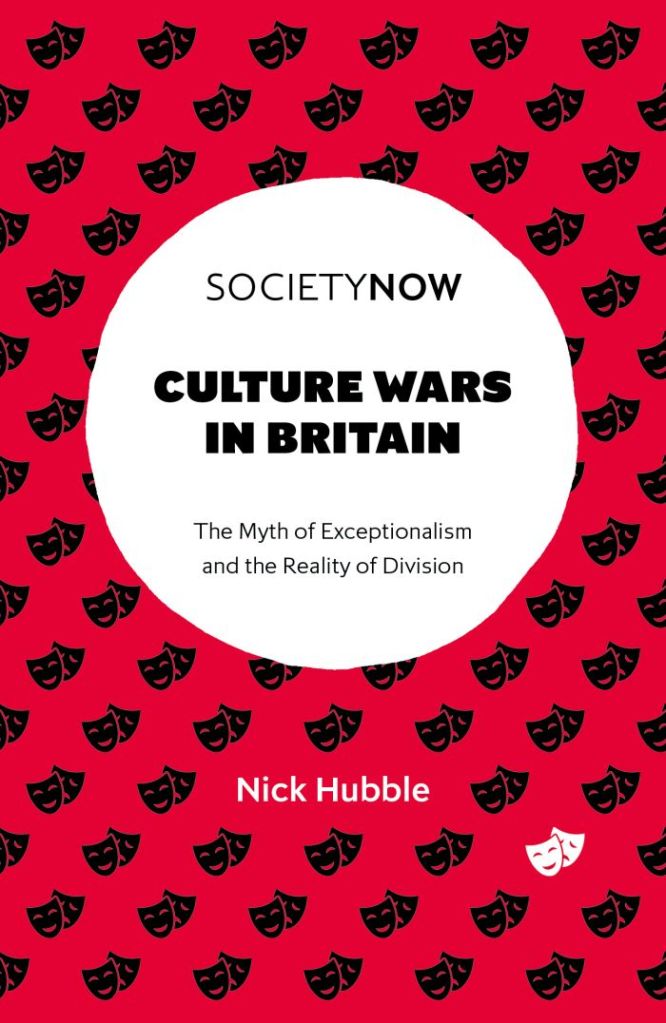
Synopsis and Chapter Summaries of Culture Wars in Britain

In the immediate aftermath of Labour’s huge victory in the 2024 General Election, new Culture Secretary Lisa Nandy declared that ‘the era of culture wars was over’. This false claim was indicative of the lack of understanding of the culture wars by Labour under Keir Starmer, which led to a spectacularly rapid collapse in support for the government and the announcement of his resignation less than two years later. Yet politicians and the British media still dismiss culture wars as an external imposition that are somehow a distraction from ‘real’ issues such as the ‘cost of living’.

My book Culture Wars in Britain challenges British scepticism towards ‘culture wars’ by showing that they are not a recent American import but date back (at least) until before the First World War to the divisions raised by the issues of votes for women and Home Rule for Ireland, which have continued to shape the UK’s cultural and political divides right up until the present.

Culture wars are now the determining factor of social and political life in Britain. What would have been considered extreme or even unimaginable political events a decade ago, such as the May 2026 local and devolved election results and the forced ousting of a Prime Minister who won a landslide majority only two years ago, are the consequence of Britain being split into two opposing blocs of socially conservative and socially liberal opinion. In order to understand what is happening to the country, it is necessary to understand the British history of the culture wars.

The book begins with a preface, in which I situate myself and explain my motivations for writing the book. This is followed by six chapters:

Ch 1, ‘What are Culture Wars?’, explains what culture wars are – outlining the main theories and academic literature – and describes the main differences between culture wars in the UK and the US, before analysing how this gap has narrowed since Brexit and converged further following the re-election of Trump. In his Inaugural Address, Trump declared that it will henceforth be the policy of the US Government that there are only two genders, male and female. Three months later, the UK Supreme Court ruled in April 2025 that definitions of ‘man’ and ‘woman’ referred to biological sex.

Ch 2, ‘Culture, War, Class and Gender’, discusses the historical relationship between gender, class, the nation state and culture wars. I look at the history of the women’s movement between 1910 and 1940 and the authoritarian reflexes it triggered. In particular, I examine the 1910 constitutional crisis, which led to the Parliament Act and the third Irish Home Rule Bill, and argue that this constitutional change effectively changed subjectivity by ending the Victorian traditional order and enabling people in Britain to become citizens rather than subjects. As George Dangerfield’s The Strange Death of Liberal England (1935) explained, the Victorian ‘Perfect Wife’ had been a ‘biological female’ who was ‘ready to be browbeaten and put upon so long as her husband remains unconsciously dependent upon her in his dual role of master and child’. Following 1910, however, human character was changed from such biological essentialism.

Ch 3, ‘The Break-Up of Normative Britain’, describes how postwar Britain, characterised by monarchy, class system and a binary gender divide was held together by normative values associated with an imaginary common culture (the historian Eric Hobsawm defined a ‘common proletarian way of life’, which he described as undermined by women going out to work), and how this fantasy broke down. I argue that the British working class was not predominantly socially conservative and that it was demand from ‘below’ that drove the comprehensive school movement and the expansion of higher education. I also discuss how from the 1960s onwards, the trajectory of nationalism in Scotland and Wales became driven by a desire to break away from the conservative common culture of postwar Britain. In contrast, Thatcher sought to appeal in part to a nostalgia for the common proletarian life and effectively fought a culture war over the restoration of traditional Victorian values. The second part of her famous claim that ‘there’s no such thing as society, only individual men and women’ resonates both with that Victorian idea of the biological female and the Supreme Court ruling of April 2025 and the anti-trans policies of the present period.

Ch 4, ‘The Brexit Divide’, shows how the rise of English nationalism drove the vote to leave the EU and has created a permanent schism between socially conservative authoritarian nationalism and socially liberal cultural progressives, which has led to the breakdown of the old two-party politics. I also discuss research on how Brexit has led to ‘new feeling rules’ that make people more reluctant to discuss such issues because of the emotional hurt from falling out with friends and family members.

Ch 5, ‘The Culture Wars in the 2020s’, explains why the 2020s have become a critical moment in British history. I identify four key contexts: Brexit (and decline of two-party politics), Covid, the death of the Queen, and the ‘small boats’ panic. I also discuss how the BLM movement in 2020 led to mainstream media and politicians adopting what has been called ‘anti identity politics’. I assess the real risk that Britain moves towards an authoritarian nationalism of the type that characterises Putin’s Russia and Trump’s America. I discuss in detail the role of English nationalism in the anti-asylum seeker protests outside hotels and the anti-trans movement (from Mumsnet to the Cass report) – phenomena which are linked by the nationalist mantra of ‘protecting our women and girls’.

Ch 6, ‘The Future of the Culture Wars’, argues that we need to abandon the wishful thinking that divided people can make common cause within the current framework of Britain. Rather, we need to learn to live with culture-war divides concerning, for example, gender and migration. We need to stop being sceptical about culture wars and think about new cultural patterns of living beyond the traditional nation state and authoritarian nationalism, which make space for difference. 

Subsequent posts will include additional material from the project and show how I am taking it forward by investigating alternative cultural patterns of living.

Preface to Culture Wars in Britain

My book Culture Wars in Britain was published by Emerald Press in May. Here is the Preface, in which I situate myself and explain my motivations for writing the book.

I was born in an NHS hospital in May 1965, twenty years after the Second World War. Greater London, comprised of twelve inner and twenty outer boroughs (including my native Bromley), had come into being only weeks before. Britain’s wartime leader Winston Churchill had died back in January, a few days after the House of Commons voted to reorganize secondary education. Consequently, I would go on to attend a comprehensive school between 1976 and 1983. Meanwhile, the UK’s higher-education provision was in the process of being extensively expanded, by the addition of ‘plate-glass’ universities, such as Essex, where I would study as an undergraduate between 1989 and 1992, and Sussex, where I would gain my postgraduate degrees between 1995 and 2002. 1960s Britain was changing and everyone knew it.

But this wasn’t the first time that Britain had changed, nor would it be the last. My parents were both the youngest children of mid-to-large-size prewar families. They both had older brothers who served during the war. My dad’s parents were both born in 1899. While my grandmother worked in a munitions factory, my grandad fought in the First World War, came home and was unemployed, before getting a job with the Metropolitan Water Board and a London County Council House. He reached the position of foreman before he retired in the 1960s. Following the 1944 Education Act, my dad (born 1935) passed the Eleven Plus, and went to a grammar school, leaving at 16 with five O levels to work in a bank. My mum (born 1940) went to a secondary modern, leaving at 15 to train as a dietitian, but, when that didn’t work out, arranged a day of interviews for office jobs in London and was able to take her pick. This was 1956. Britain had full employment, and the postwar years of austerity were over.

Social and sexual attitudes were already rapidly changing when my parents married in 1962. By 1970, when my sister was born, the death penalty had been abolished, divorce liberalized, and abortion and homosexuality legalized under certain conditions. In 1973, at a time when some of the older teachers at my primary school were still regularly reminding us how lucky we were not to have to speak German, Britain joined the ‘Common Market’ of the European Economic Community (EEC). Not that I ever went to Europe as a child apart from a 4-day trip with a church youth group. We spent our family holidays in my uncle’s static caravan near Hailsham. In 1976, when I started at my local comprehensive school, Britain was, according to some metrics, the most socially equal country in the world. It was no longer a country where people needed to keep to their place according to class or gender. Our teachers, especially the younger ones, were conscious of the fact that they were educating their students for a new society.

In 1979, Margaret Thatcher’s Conservative Party came to power and instigated a further raft of economic and social changes. By 1983, when I sat my A levels, Britain had 3 million unemployed. I turned 18 just in time to vote differently to my Tory-supporting parents. Over the next few years, as I embraced causes such as anti-apartheid, unilateral nuclear disarmament, lesbian and gay rights, and the miners’ strike, our social and cultural values diverged. Making friends from other parts of Britain while studying Zoology at university in Bangor – where the native language wasn’t English but Welsh – made me realize how suburban my perspective on life was. Even so, I couldn’t handle being away from home and dropped out.

While alternating periods on the dole with dead-end jobs, I was inspired by the radically diverse politics of the Greater London Council (GLC) until the Thatcher government abolished it in 1986, following a sustained culture war of fabricated press stories mocking its anti-racist and pro-LGBT policies. I also broadened my cultural horizons by watching European films with subtitles on Channel Four, which had been launched in 1982. I remember my dad once asked me during one particularly obscure late-night offering, ‘Is this any good, Nick?’ I didn’t know. I had no criteria at that time by which to make an informed assessment. I knew I wanted it, though, whatever it was.

But even then, I didn’t go to Europe. Instead, Europe came to me. While working at a local Shaftesbury Society FE college as a classroom assistant on a community programme scheme, which paid me £20 per week on top of my social security benefits, I met a West German volunteer on her gap year. During the golden year of 1989, in which the world turned on its axis and the Berlin Wall fell, I gained an A level in English Literature in evening classes and a partner for life

My mum’s last words to me as I left home (the second time) that autumn to go to university, age 24, were ‘don’t fornicate’, despite (or possibly because of) the fact that I was going together with my girlfriend, who had decided to study in the UK. Some would say that maybe my mum had a point. By 1992, when we graduated, my girlfriend was pregnant, I was unemployed and we were still unmarried. But the times had changed; it didn’t stop us living our lives. Our oldest child was born, we completed various postgraduate degrees (with the benefit of cheap credit), we eventually got married and had a second child.

As the Britain of the 1990s segued into the 2000s, once more under a Labour Government, it seemed as though the dark days of the 1980s had finally been banished to the past. Greater London regained an elected governing body. Scotland and Wales acquired assemblies, which later became parliaments. In England, the cross of St George began to flourish in public even as the football team became increasingly multiracial. But Britain also became embroiled in the American War on Terror, fighting in Afghanistan and Iraq, despite millions of us marching in opposition.

In the aftermath of the 2007-08 global financial crisis, the UK government changed at the end of the decade and introduced austerity economics in a conscious evocation of the immediate postwar period. We went on demonstrations against the cuts. In 2012, university tuition fees were raised to a staggering £9,000 per year. Same-sex marriage was legalized with public support. The tectonic plates of British social and cultural life continued to shift.

By now, my wife and I, both full-time academics, and our three children were living in Wales, where I voted yes in the 2011 referendum for increased legal powers. I supported the yes side from afar in Scotland’s fiercely contested independence referendum in 2014, then watched some of that intensity spill over into the 2015 UK General Election, which the Conservatives won in part by running on a specifically English manifesto in England. The final act in this open emergence of division was the UK European Union membership referendum of 23 June 2016. On a personal level, the result for both myself and my wife, who didn’t even have a vote despite having lived in the UK since 1988, was devastating.

Far from living in some hypothetical ‘bubble’, we knew plenty of people who voted ‘leave’, including my dad and my best friend in academia, alongside various acquaintances, relatives and old school friends. My mum, however, voted remain and thus my parents cancelled each other’s votes out. Was there ever any tension between my wife and I and my dad resulting from this? There were a couple of touchy moments but no more than one might expect in normal family and friend gatherings anyway.

My experience of the leave voters I knew was that they voted for what they thought were good reasons and that, by and large, they were sympathetic of problems that this might have caused others and, for example, took a supportive interest in my wife’s progress in applying for a British passport. For all that our social and cultural values might be very different, in both the case of my dad and my academic friend, there was a tacit agreement that the relationship was more important than those differences; indeed, it wasn’t even a question.

Until that point, as we shall see, the term ‘culture wars’ had hardly been used in the media in a British context. Such matters were treated as an American phenomenon. Of course, attitudinal differences were tracked as part of the British Social Attitudes survey and political polling more generally. Focus groups had played a major role in New Labour’s strategy from the mid-1990s. A correlation between liberal values and the yes vote in the Scottish Independence referendum was observed and appeared again in relation to the remain vote in the EU referendum. But even in 2017, after the outcomes of both the Brexit vote and Donald Trump’s victory in the 2016 US Presidential Election, it was not yet apparent how to politically leverage these cultural divisions. Hence, the disastrous General Election campaign fought by the Conservatives under Theresa May in 2017.

Indeed, even after that election, the Conservatives were still committed to making progressive reforms to the 2004 Gender Recognition Act and carried out a public consultation on this in 2018. This was another subject of personal importance to me because since 2014 I had been publicly identifying as nonbinary. I expected that, once the reform of the GRA proved successful, legal recognition of nonbinary identities would follow. However, that wasn’t to be. A new stage in the culture wars was coming.

Following May’s replacement by Boris Johnson in 2019 and the Tories’ subsequent General Election victory in December of that year, conscious discussion of the culture wars in Britain suddenly took off. In 2020, there would be over 500 British newspaper articles focusing on the existence or nature of culture wars in the UK.

The sudden emergence of a powerful ideological narrative claiming that a silent majority of ordinary people were throwing off the shackles imposed upon them by a metropolitan elite would have been a culture shock under any circumstances. However, its combination with the Covid pandemic, which highlighted the entrenched social and economic inequalities in the UK, was surreal. Despite the fact I was working from home, rather than being furloughed, I still had plenty of time to reflect on this process by which the progressive values I had believed in and lived by had suddenly become portrayed as some sort of rootless virus, like Covid-19 itself.

Of course, other people were also thinking about these matters, and the evidence suggests that some people in positions of power in institutions, such as the BBC, actually took these criticisms on board and concluded that they had allowed themselves to become out of step with ordinary people. Suddenly, they felt guilty for imposing their own elite values. I guess being out of touch with ordinary people might be a potential worry for those who have been to elite schools and universities; especially for those who might think they are inherently more privileged than the wider public. However, I don’t know for sure because I didn’t go to an elite school or university and I’ve never considered myself inherently privileged over the wider public. Therefore, I didn’t internalize guilt for being part of some sort of conspiracy to impose liberal values upon an unwilling public. Or, indeed, succumb to the belief that any such thing had happened.

Instead, I started investigating how social change works if we assume that it is not simply imposed on a passive population by enlightened reformers but rather driven by the needs and desires of ordinary people. In investigating this matter by analyzing diaries, memoirs and other forms of life writing, including autobiographical fiction, what I discovered was a much longer and deeper British culture war dating back until at least the First World War.

As has long been understood, that war shattered the old hierarchical Victorian class system and collectively empowered ordinary working people such as my grandparents. However, a focus on the economic and political aspects of this class system has often precluded appreciation of how much of this struggle was fought over cultural terrain. Viewing social change through the prism of a century of British culture wars reveals a history that radically differs from the standard historical narratives of both right and left. Relating this longer history to the ongoing post-Brexit explosion of culture wars in the UK has turned into a major project, of which this book is the first instalment.

Why am I telling you all this? There are several reasons.

First, I am not going to pretend to be neutral in my personal beliefs because I think that’s particularly unhelpful in relation to the broader topic of cultural values and the conflicts that arise from them. Nobody is genuinely neutral in these matters; indeed, the insistence that there is some sort of objectively fair middle ground in the culture wars causes far more harm than the acceptance of there being genuine division. There is no magic solution. We are not going to return to some mythical British common culture. We urgently need to learn to live with difference.

Second, as this book will demonstrate, self-reflexivity – the capacity to think about oneself from the outside and then use this understanding to shape one’s actions – is characteristic of how people live in the modern world and shape their lives in accordance with the society around them. Self-reflexivity is what allows us to assess social norms and decide whether we want to find ways of living outside such conventions. Without conscious self-reflexivity there is no possibility of finding a new cultural pattern of living which might better accommodate difference. I’ve tried to incorporate some of my own self-reflexivity into the process of writing this book.

Third, I offer this synopsis of my story, which is not unusual for British people of my age in some respects but less common in others, because one thing we need to remember when talking to each other is that people’s cultural values and attitudes are generally underpinned by their lived experiences. When we touch upon core beliefs and personal values, we are dealing with passions that run stronger than opinions on abstract political positions. In this respect, the story of the culture wars in Britain is the story of our lives and how they have changed over the course of the last hundred years. We should all take the time to think about that.

I would like to acknowledge the support of the Leverhulme Trust, who awarded me a Research Fellowship during the academic year 2023-24 for my project, ‘Self-reflexivity, Class Consciousness, Culture Wars and Social Change in Britain’. Thanks to the respective conference organizers for allowing me to present on my research at ‘Crisis, Continuity and Change: the British Sociological Association Annual Conference’, 3-5 April 2024; and at ‘(Re-) Drawing Borders: When and Where was the United Kingdom?’, Centre for British Studies, Humboldt University, Berlin, 12-14 December 2024. I have also benefitted from arguing about ideas with colleagues at Brunel and giving my professorial lecture, ‘Culture Wars and Social Change in England’ on 23 April 2024. More generally, I need to acknowledge my good fortune over the years to have spent so much time productively discussing related ideas with academics, writers and critics in social science, modern and contemporary literature, and science fiction circles.

Thanks to all the editorial and production staff at Emerald Press for making writing this book such a rewarding and agreeable process. I would also like to express my gratitude to the three anonymous readers of the proposal for this book, who raised good points and gave helpful advice.

Last, but not least, thanks to Osian, Max and Alex and, above all else, to Andrea.

Notes on Social Reality and British Nationalism

In this post, I am just noting a developing trend in the way that articles in the non-right-wing (for want of a better way to phrase it) media are reporting social attitudes as ascertained by polling as reflecting social reality or mainstream opinion. The purpose of this is presumably to get their ‘non-right-wing’ readership to change their attitude in line with this ‘new reality’.

For example, according to Sam Taylor Hill, John Denham and Tariq Modood’s article, ‘Beyond Division “Multicultural Nationalism” and the White Working-Class’ in the September 2025 issue of Byline Times (I should note that this article was out-of-step with the generally progressive values of the rest of this issue):

… the disadvantages of economic decline in former industrial and coastal communities, poor social mobility, educational under-achievement, poor health, and the lack of voice and influence found in many white working-class communities sets their lives far apart from politically confident white graduate professionals or the more successful parts of minority communities. This is often felt as a sense of loss of their part in a nation to which they were once central. It can be expressed as resentment if others – minorities or newcomers – are perceived as getting priority, attention, and higher status. These white working-class communities feel excluded from the sense of privilege that being part of the ‘majority community’ was supposed to confer.

Statistics show little real difference between disadvantages in white and ethnic minority working-class communities. Some argue against even talking about the ‘white working-class’, lest it prevent the expression of unified working-class politics. But this misses the point. Right-wing populists can mobilise sections of the white working-class because it does exist as a social reality. It is marked out by demographics, geography, education, history, values, ideas of nationhood and, often, a physical separation from the lives of those who apparently face similar social problems.

I don’t have space to unpick the huge historical claim being made here. My point is that the purpose of this kind of argument is to invalidate critics of the concept of a ‘white working class’ as ‘missing the point’ and not having a grasp of ‘social reality’. I need to trace the logic of this usage of ‘social reality’, which has some grounding in sociology. For example, I’ve seen the term used to argue that certain facets of nation states are in effect social reality that can’t be altered. So, the implicit argument here is something along the lines of claiming that a ‘white working class’ is a core part of the social reality of Britain as a nation state.  

In similar vein, in an opinion column on immigration for the Financial Times on 28 August 2025, Farage is winning the new battle of Brexit, Robert Shrimsley notes

Even so, the impact of his summer campaign has left centrists warning against dancing to Farage’s tune. They argue that talk of an eruption of protests outside asylum hotels has so far turned out to be mostly only a few hundred people. Above all, liberals urge Keir Starmer to fight back against the dehumanising rhetoric of the right.

For those who recoil from the right’s tactics, these are seductive arguments. Scorn is a comforting reflex. But this is where Brexit memories are instructive because we have seen this movie before. The past decade was a masterclass in how to misread a nation.

For when majorities are telling pollsters that the issue is their main concern, the battle has to be fought where it is, not where you wish it to be. Like it or not, the belief that mass immigration has gone too far, that control has been lost and that integration is failing is now a mainstream opinion. 

Shrimsley’s scorn is clearly directed at ‘liberals’ (a pretty meaningless phrase in the context of British politics, but one that has been borrowed from the US) for failing to realise that ‘mainstream opinion’ has shifted. It’s not clear to me why that was already obvious from Brexit given that one of the distinctive features of that experience was how evenly split the electorate was on the issue. The implication here is something along the lines of a claim that Brexit has altered social reality. On one level, this seems to be confusing changes in behaviour of the mainstream political parties with social reality per se.

It has become commonplace in recent months for UK media commentators to argue that ‘recently, the Overton window – the range of ideas and policies considered politically acceptable – has widened on immigration’ – this is George Eaton writing in the New Statesman this summer. Among a list of examples supporting his claim, Eaton cites Farage’s declaration that the UK is facing ‘societal collapse’, which was backed  by the former Tory cabinet minister and current editor of the Spectator, Michael Gove, but also an unnamed Labour MP calling for an ‘“Immigration Sovereignty Act” that unilaterally reforms articles 3 and 8 of the European Convention on Human Rights’. Eaton also reports that many Labour MPs are in contact with former Prime Minister Tony Blair, who apparently believes that ‘the country wants someone to take it by the scruff of the neck, lead it and shake things up’. This seems to me to be a fair journalistic account of what has been happening, which is that a hard anti-immigration consensus has been forming across the political establishment.

In this context, the pieces in Byline Times and the FT can be seen as attempts to shift sections of the public who read these kinds of papers behind this new political consensus. In some ways, it might be seen as a form of gaslighting in which ‘liberals’ are told that the world doesn’t work the way that they think it does; ‘racism is all in your mind, social reality has changed now, so you need to get in line with mainstream opinion’. So, it’s basically propaganda. However, the way it’s framed in terms of ‘the nation’ and in defence of British values is telling about the ultimate agenda here, which is a fairly explicit form of British nationalism. Although in practice this is often the external expression of English nationalism (as evidenced by the current profusion of English flags alongside the union flag in anti-asylum seeker protests). Tellingly, another recent article in the New Statesman claimed that ‘Politically, at least, Britain is becoming more, not less, like Clacton’. The slip here is that it’s England (outside London and the other big cities) that is becoming superficially more like Clacton, not Britain as a whole.

While this agenda is not new, the current intensification is reaching new levels. This coordinated embrace of a British nationalism as a new social reality is part of a wider international shift towards authoritarian nationalism. I aim to publish more blogposts on this process over the course of this autumn, as part of wider ongoing research.

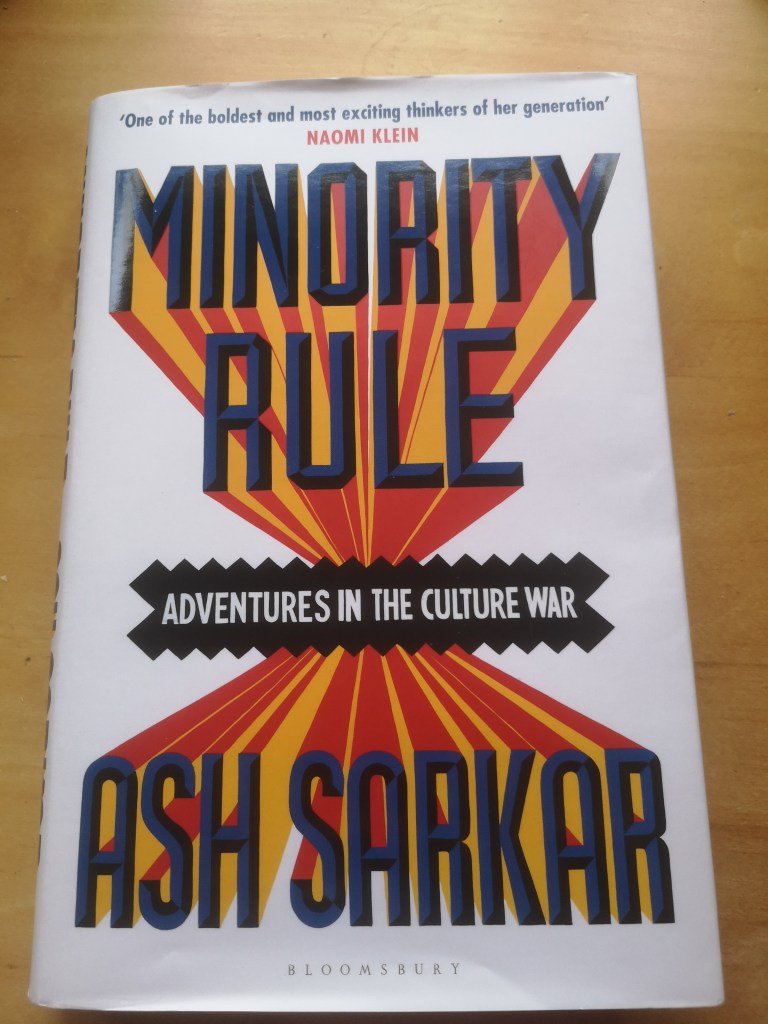
Neoliberal Anti-Identity Politics and the Need for the Left to Rethink the Culture War: A Review of Ash Sarkar’s Minority Rule: Adventures in the Culture War (Bloomsbury, 2025)

In their 2022 book, Fractured: Race, Class, Gender and the Hatred of Identity Politics, Michael Richmond and Alex Charnley warn that:

The easiest thing to communicate is that power corrupts. The problem is that the hypervisibility of a liberal multiracial public sphere is now being used as evidence to propagate a reactionary myth that minorities rule, minorities corrupt. The tendency of the electoral left to look to centrist politicians for signs of ‘hegemonic neoliberalism’ has meant that they have become politically blind to the international spread of neoliberal anti-identity politics. [. . .] Imagining that every kind of contemporary anti-racist or feminist politics is yet another expression of neoliberalism verges on the reactionary and fast-tracks some comrades right over to the other side. (5)

Fortunately, Ash Sarkar clearly does not imagine that every kind of contemporary anti-racist or feminist politics is yet another expression of neoliberalism. There is no reason to think that she is on the way over to the other side. But, even so, there were moments reading (the incredibly badly titled) Minority Rule when I was reminded of Angela Nagle, who is the cautionary example of such a trajectory given by Richmond and Charnley. For although Sarkar does not argue anything so self-evidently ludicrous as that people posting about alternative gender identities on Tumblr are directly responsible for the Trump ascendancy (the basic thesis of Nagle’s 2017 book, Kill All Normies: Online Culture Wars from 4Chan and Tumblr to Trump and the Alt-Right), she does broadly position herself in the same territory:

I’m going to examine how the weaknesses in progressive arguments about identity politics helped set up the trap created by the right in their mobilisation of the Minority Game [. . .] You’ll see how scaremongering about Minority Rule has created the conditions for an authoritarian power-grab in the UK and America. (20)

There is also a section in which she discusses some ‘niche controversies’ on twitter and concludes that arguments about language ‘have made liberal identity politics an unwitting accomplice in the right’s backlash against progressive politics’ (50). Later she writes that ‘one of the reasons that it’s not so easy to dismiss this relentlessly negative depiction of the left in the media is that many people have direct experience of getting drawn into hostile debates on social media’ (99). Really? The number of people who get drawn into the replies and comments is a subset of the subset of the population who use social media and Sarkar only discusses twitter in any case. Most people’s vague understanding of twitter comes from selective reporting in legacy media. To get distracted by this stuff – the replies and comments – is to get distracted by what Richmond and Charnley characterise as neoliberal anti-identity politics.

If there’s an overall intended historical thesis to Minority Rule, it’s that the right has taken advantage of identity politics ‘to destroy and enfeeble the engines of class consciousness, which tied people’s sense of social identity to their material conditions’ (143). However, what Sarker shows in practice is not the right reacting to supposedly liberal identity politics but the right increasing pursuing an agenda of authoritarian populism in the face of social change and leftwing attempts to build a collective and inclusive alternative. In other words, Minority Rule offers a profoundly mixed message. It seems to be addressed simultaneously to two different audiences: the post-2008 left and the wider public who watch the kind of mainstream news shows that Sarkar appears on (and who presumably form part of the intended market for this mainstream book). There’s slippage between exposing the way the right highlight fears of marginalised minorities to distract us (the public at large) from the massive economic inequality which pervades today’s Britain, and exposing our (the post-2010 left’s) complicity with identity politics in order to seek approval from … well, from what theorists might term the ‘Big Other’ (some collective embodiment of the card-carrying class-conscious capital-L ‘Left’). At the same time, much of Sarkar’s most effective analysis highlights the assault of the rightwing governments of the past 15 years on trans people, asylum seekers and refugees, workers and young people more generally. In other words, the book is above all an extended piece of leftwing journalism. Reviewers have picked up on these mixed messages. Thus, the review in Tribune by Rebecca Alexander highlights the general message for the wider public: ‘Instead of pursuing a common goal — dismantling the structures that sustain inequality — we have been conditioned into fearing the wrong kind of minority (i.e., the marginalised rather than the wealthy). If we are made to fight among ourselves, so the theory goes, they can get away with more’. But also acknowledges both its journalistic nature and exhortatory message to the left: ‘In the final instance, Minority Rule is more diagnostic than prescriptive [… ] she has at least done a great job of trying to steer the left back in the right direction, and — just maybe — pick up some new comrades along the way’. The review also commends Sarkar on her ‘humility’ and ‘self-awareness’ in confessing that she ‘got Brexit wrong’, which, as we’ll see, is not actually quite what she does. Nevertheless, I think this review probably gives an accurate indication of the response that Sarkar was aiming for. However, I also think that if this is the case, she is doing a disservice to herself. For all its faults, the book deserves to be seen as something more than a contrite account of the importance of returning to the fold. At the very least, it illustrates some of the ways that the left is tying itself in knots over anti-identity politics and the culture war. Therefore, I provide a more detailed and extensive analysis below.

What is to Be Done?

Towards the end of Minority Rule, Sarkar writes:

Anti-trans hostility, the Great Replacement and attacks on abortion rights are all part of the same demographic panic. It’s all about controlling who gets to determine the composition of the nation. By claiming that the increase in openly transgender people is the result of ‘social contagion’ (rather than, you know, society being a bit less queerphobic than it used to be), it opens up an avenue for state control of people’s bodily autonomy. You can’t let one person be trans in peace, lest it leads to dozens more. And if your overriding priority is to boost the population of the white breeding stock, of course you’ll clamp down on reproductive freedoms and turn back the clock on LGBTQ rights. Because unless people’s ability to live their lives in the way of their own choosing is drastically reined in, who knows what kind of nation they’ll produce? Ethnic diversity will increase inexorably, and the dominant group, whether it’s white people in Europe and America or Hindus in India, will cease to enjoy the advantage of numerical superiority. Racism, however, has never been a simple numbers game. Whether it’s the apartheid regime of South Africa or Israel’s control of the West Bank and illegal settlement construction, some societies have chosen forms of de jure minority rule over multi-racial society. Such nations define themselves by supremacist ideology – and implement ever more authoritarian means in order to uphold it. That’s the choice facing societies across the world: embracing multi-racial democracy, or the myth of identitarian supremacy. (243-4)

Reading this, you’d assume that the overall argument of the book is for an intersectional socialism in which different struggles are linked and shown to be part of one bigger struggle against capitalism and the capitalist ruling class. In fact, much of Minority Rule does broadly correspond to that position. However, this is not the case with the introduction, the first chapter, the concluding epilogue and the way that the book is framed overall. In these sections, the message is that:

… something at the very core of us has been transformed by decades of rentier capitalism and ideological neoliberalism. We’ve lost faith in our ability to change things. We’ve come to doubt the value of working with people who don’t perfectly resemble us. We’re suspicious and punitive, building barriers and tripwires to confirm that other people are not to be trusted. We make sameness the condition of solidarity. This pervasive feeling of woundedness and wariness is a product of the left’s historic defeats over the past forty years – we’re like this, because we’ve been losing. But it’s also time to admit that we’ve been losing because we’re like this. We can’t achieve anything while minoritising ourselves.

This doesn’t mean throwing away identity-based struggle and ignoring the brutal injustices of racism, sexism, ableism, homophobia and transphobia. But if we continue to insist that minorities can fight alone, we’re consigning ourselves to losing alone. We can no longer afford to disappear into the solipsism of feelings; its imperative that we pull our heads out of our arses and refocus on the material harms which exist outside of individual subjectivities. (266)

This carries on a bit longer, telling us not to ‘dedicate ourselves to policing the boundaries of our own moral purity’ and … well, you get the idea. This is the conclusion to the whole book. If you just read this section on its own, you might assume that the book is full of examples of woke snowflakes disappearing up their own individual subjectivity in pursuit of their moral superiority, but it isn’t. Just about the only piece of anecdotal evidence in the book that might be interpreted in that way comes at the beginning of chapter 1, ‘How the “I” took over “Identity Politics”’: ‘It was when the silver-haired climate activist called everyone in the room “a bunch of fucking cunts” that the wheels began to fall off’ (23). This was an October 2023 event in Liverpool bringing the radical left together to discuss ‘What is to be done?’ The result, as Sarkar reports was that people got very upset and were unable to move on to discuss sensible matters such as whether the Labour Party is a useful vehicle to organise in. As the complaints continued, Sarkar reports herself thinking of the fate of activists such as Fred Hampton and Trotsky and concluding ‘if we couldn’t cope with a stern climate activist calling us a bunch of fucking cunts, what hope had we of taking on the state?’ (25). This rather bizarre stream of hyperbole doesn’t distract from the fact that this example is any case not really illustrative of the point being made. For a start, the activist in question was Roger Hallam of Extinction Rebellion, who is a divisive figure even amongst climate campaigners. More importantly, though, is that there is a long socialist history of organising public meetings and events according to rules and procedures ensuring that meaningful debates take place and collective decisions can be worked out. One of those rules is generally that speakers are not gratuitously offensive to the audience for precisely the reasons demonstrated by this example. Therefore, my socialist analysis of the problem (from the information provided here) is that there weren’t effective guidelines in place for the event. Sarkar’s analysis, however, is that this is a typical example of the left ‘immobilising itself over matters of identity’ (26). Likewise, she provides some examples of twitter storms later in the chapter that I agree are fairly ridiculous but don’t see as somehow explaining the left’s inability to mobilise in the ongoing political crisis of recent years.

Identity Politics

Sarkar notes that she is aware that some of her friends are going to be annoyed that she is writing this but insists that ‘because we’ve embraced a version of identity politics in which individual experiences trump collective realities, the right has been able to appropriate it as a weapon for their own ends’ (26). Now, this sentence does a lot of work in carrying the freight of the overall argument of the book, which seems to be that all the right-wing culture war attacks she writes about in chapters 2-7 were ultimately enabled by the left absorbing the tenets of liberal identity politics and becoming obsessed with moral purity rather than collective action.

Sarkar’s historical argument is that identity politics originated with The Combahee River Collective Statement published in 1977 and was originally ‘unambiguously anti-capitalist, collective, and international in its scope’ (31). However, over time the concept has become detached from a clear sense of material priorities and ‘become a largely middle-class preoccupation, due to its spread in elite universities … in the competitive yakkety-yak of arts and humanities seminars’ (46). In this way, and through its spread to the media, we are told that identity politics has become ‘the master-frame through which political conflict is understood’ (59). In response, however, the reactionary right has managed successfully to represent this form of identity politics as solely a means of legitimating and advancing the cause of women, queer people, racial and gender minorities over that of the ‘silent, censored, forgotten or abandoned majority who are under attack by minority causes’ (59).

There are several problems with this account presented by Sarkar. Apart from anything else, it simply doesn’t work historically because the right was deploying the trope of the silent/hidden majority long before the term ‘identity politics’ had been coined. For example, Nixon was using it in the 1960s, but the idea has been employed implicitly by authoritarian populists since at least the nineteenth century: it wasn’t indirectly enabled by the post-1989 expansion of the UK HE sector and too much ‘yakking’ in English Lit seminars. The biggest problem with the book, though, is that the title, Minority Rule, aligns it directly with the reactionary myth propagated by culture warriors such as David Goodhart and Matthew Goodwin that the UK is really ruled by a minority metropolitan elite trying to impose liberal diversity on the Great British public. Sarkar is perfectly aware of this and indeed defines ‘Minority Rule’ in her introduction as ‘the paranoid fear that identity minorities and progressives are conniving to oppress majority populations’ (11). Her justification for using this title nonetheless is that she is exposing how the real elites ‘(as in, the real ruling minority of hedge-fund managers, press barons, landlords, corporations and oligarchs)’ use Minority Rule as cover for their authoritarian and antidemocratic activities, while playing minorities off against each other. In other words, the book’s justification is that it will show us ‘how the paranoid fantasy of Minority Rule upholds a real minority rule, by keeping us divided and competing against one another for attention’ (20). The trouble with this is that there is just too much slippage between the terminology. By describing the right’s characterisation of identity politics in the way she does, Sarkar effectively endorses it. The approving reader of Goodhart or Goodwin will be nodding their head along with most of this too. The rightwing press has the option of using it as fuel for its usual ranting, as demonstrated by these Telegraph articles, ‘The Queen of woke just exposed the hypocrisy of the virtue-signalling Left’ and ‘Even a “literal communist” like Ash Sarkar knows the Left is in crisis’, or slating it as in The Sunday Times’ dismissal of it as a ‘misery memoir’.

My impression from reading the book is that Sarkar hasn’t internalised the right’s arguments directly but more likely indirectly via criticisms made by sections of the left and old left. There’s a telling confession later on in which she admits to feeling ‘a horrible sense of personal responsibility’ for the outcome of the 2019 General Election:

I wrote articles arguing that Labour should take more of a pro-EU stance than a pro-Brexit one. I lobbied hard on things like more ambitious climate commitments, ending immigration detention and adopting universal basic income. I forget the number one rule in politics: learn how to count. Because there were far more people in the country who weren’t like me than those who were. As I trudged around news studios after the exit poll came out … I could feel a narrative emerging around me. Metropolitan elites like me had lost the working class. (135)

In this respect, the book can be seen as an extended apology and public penance. Obviously, many people felt depressed after the 2019 election. I don’t want to downplay that reaction (I can remember how absolutely awful I felt after both the 1987 and 1992 elections, absolutely devastated). However, there really are pitfalls in letting the electoral cycle of party politics impact on your thinking. Despite the absolute victory for Johnson’s Tories in that election, we know that the result was decided at most by a few hundred thousand voters across 30-40 constituencies. It wasn’t a landslide however much the mainstream media presented it that way (similarly, Trump’s 2024 election victory was not a landslide or even big win: he still took less than 50% of the vote). There were not actually far more people in the country who didn’t agree with Sarkar’s 2019 political positions than did agree with her. In other words, there is no need to apologise!

Cultural Materialism

Nevertheless, Sarkar also apologises, on behalf of the twenty-first-century left, for ‘chuck[ing] the idea of material truth out of the window’ (28), which she equates with the abandonment of the idea that we all live in a shared reality. We need to return to good old-fashioned twentieth-century materialism:

Materialism is the idea that it’s real-world conditions that shape consciousness and not the other way around: so if you want to understand a person, or a whole community of people, you should look at the distribution of wealth, resources and access to power. (27)

This comes close to a crude Marxist analysis of false consciousness. Ok, this isn’t a theoretical work and no doubt there were editorial pressures on Sarkar shaping what she could write. But, even so, this is a simplistic take on a complex issue. By coincidence, the latest issue of New Left Review came through my letterbox while I was writing this review and it includes an article by Perry Anderson touching directly on these kinds of arguments by examining whether ideas ‘are mere mental epiphenomena of much profounder material and social processes, or do they possess a decisive autonomous power as forces of political mobilization?’ Anderson argues that ‘those [ideas] which are relevant to major historical change have typically been systematic ideologies’, but within a few lines he develops this formulation by suggesting that what is meant by ‘systematic ideologies’ can be readily substituted by culture as conceived by T.S. Eliot (or, I would like to add, by Raymond Williams). In this respect, it is conceivable to think of a ‘culture war’ that would function in the manner of a clash between systematic ideologies and have genuine historical (and material) consequences. Now, I am well aware that this is not generally how the term ‘culture war’ is understood by the media or by Sarkar, but I think we’d be well advised to keep this (hard, if you like) version at the back of our minds.

Anderson goes on to conclude that history shows ‘that ideas count in the balance of political action and the outcome of historical change’:

In all three of the great cases of modern ideological impact, the pattern was the same. Enlightenment, Marxism, Neoliberalism: in each case a system of ideas was developed, to a high degree of sophistication, in conditions of initial isolation from, and tension with, the surrounding political environment – with little or no hope of immediate influence. It was only when a major objective crisis, for which it was in no way responsible, broke out, that subjective intellectual resources, gradually accumulating in the margins of becalmed conditions, suddenly acquired overwhelming force as mobilizing ideologies with a direct grip on the course of events. Such was the pattern in the 1790s, the 1910s, the 1980s. The more radical and intransigent the body of ideas, the more sweeping its effect, once unleashed in turbulent conditions. Today we are still in a situation where a single dominant ideology [i.e. neoliberalism] rules the greatest part of the world. Resistance and dissent are far from dead, but they continue to lack systematic, uncompromising articulation. None will come, experience suggests, from feeble adjustment or euphemistic accommodation to the existing order of things. What is needed instead, and will not arrive overnight, is an entirely different spirit – an unflinching and where necessary caustic analysis of the world as it is, without concession to the arrogant claims of the Right, the conformist myths of the Centre, or the bien-pensant pieties of too much of what passes for the Left. Ideas incapable of shocking the world are incapable of shaking it.

The admonition to those passing for the left no doubt applies to me, but nonetheless I accept the diagnosis that we are in a global battle to establish a new mobilizing ideology. I would argue that this battle is exactly what characterises the bigger, deeper Culture War, underlying the smaller pettier ones that Sarkar and the media in general focus on. One of the bones of contention is ‘liberalism’. This is a term that nowadays has many different meanings. When Sarkar talks about a turn to ‘liberal’ identity politics, she’s not referring to either Liberal Democrats or nineteenth-century ‘Classical Liberals’. Rather, she is using ‘liberal’ in the denigratory sense popular amongst sections of the left in the UK and US, where it stands for people who are not ‘us’ but not conservatives either, with the implication being that such ‘liberals’ have internalised neoliberalism. However, there is another loose sense in which pretty much everyone from Jeremy Corbyn to Boris Johnson, including both Ash Sarkar and myself, is ‘liberal’, which is that we all embody post-Enlightenment ‘individual subjectivity’ – to employ a term that, as we have seen, is used by Sarkar. We’re not going to build a more equal, collective, intersectional and intersubjective society by talking tough about ‘materialism’ – or describing it as a ‘scientific method’ (27) – and pretending that we don’t have this individual subjectivity. Meanwhile the right is starting to coalesce around a programme of ‘ending’ liberalism and becoming ‘sovereign individuals’, while dismissing individual subjectivity as a ‘luxury belief’. Admittedly, for all the right’s talk of the failure of liberalism, theirs is also self-evidently a post-liberal project – but then, the right isn’t hindered by requiring a rationally coherent intellectual position to be the foundation of its systematic ideology. The left is always under a disadvantage in this respect.

So, if the above is something like the state of the current struggle of ideas between the right and left, the question is how does Minority Rule help the cause of the latter? The answer is that because of the framing at the beginning and end of the book, and the fact that this framing in entrenched through the choice of title, it doesn’t help much and is most likely a hindrance (although, as I’ve said, much of the rest of the content is on the whole better than the framing).

Culture War

Apart from anything else, the trouble with arguing that we should pay more attention to economic relationships, is that economic explanations also function ideologically, especially in the UK. For example, the limitation of framing British politics through the lens of ‘austerity’ is that we are actually distracted from the cultural and ideological consequences of government actions. In the US, the DOGE attacks on government programmes, accompanied by Elon Musk’s performative chainsaw wielding, are being seen for what they are: a systematic attack on the sociological systems – education, welfare etc – that make up a functioning state. The New York Times is currently full of articles bemoaning ‘The End of the University as We Know It’ and the fact that Academia is ‘Facing a Campaign of Annihilation’. In other words, in the US there is actually public discourse surrounding what is actually happening. The same things are happening in the UK, but because everything is being portrayed in terms of the needs for public spending cuts and the costs of rearmament, there is an almost comical indifference to the wholesale destruction of the social and cultural order. A Labour Government, some of whose ministers intervened to bail out the banks in 2008, are perfectly happy to sit back and watch the UK HE sector completely implode on their watch. Keir Starmer can blithely talk of decimating public service and replacing it with AI with virtually no consequence. It’s precisely because of a British fetishisation of the (narrowly-defined) ‘economic’, that we have no defence against the all-out cultural assault currently being waged upon us by a political party that even today some people (although not many to be fair) still see as a ‘class party’. Ok, as Sarkar points out, the British press don’t focus on the unremitting process – originating in the 1980s but in full flow since 2010 – by which neoliberal outsourcing siphons public wealth more-or-less directly into offshore tax havens (the main reason the UK economy has been stagnant since the financial crisis). But even if they did, it would still be viewed in economic terms – I’m not sure it would help immediately in the explanation of what is actually happening to us.

In Britain you have to go back pretty much to the time of Raymond Williams to find a period when the left last had the cultural and political tools to explain what was at stake in British society. Tellingly, Sarkar has to engage in the speculative fiction of imagining what it would be like if air was privatised to try and explain what has happened to us over the last 15 years or so (see 245-7). This is reasonably effective, but it doesn’t capture the brutal, unprecedented cultural impoverishment (by cultural, I mean in Williams’s sense of ‘a whole way of life’, not ‘high culture’) that has been the real hallmark of these years. Rather than demonstrating, as Sarkar suggests, the consequences of the left internalising ‘an individualistic and competitive model of victimhood’ (248), her analogy exposes the limitations on political analysis that result from the left losing track of the fact that culture is also material and politics are therefore always inherently cultural as much as they are economic.

If Minority Rule had a different title and a different framing, it would be easier to read the later chapters as intersectional left critiques of right-wing culture attacks which are seen for what they are, rather than as indirect evidence of the guilt of ‘identity politics’ in initially legitimating a politics of grievance which the right have been able to appropriate. However, even here it is necessary to present a certain narrative of a class-conscious (working class) country being split by identity politics in order to construct a majority for the right. This requires a somewhat dewy-eyed account of 1945-1979 postwar Britain when ‘working-class people voted labour as a bloc’ (144). It should be said that not all of them did and furthermore that at least the last decade of that period was characterised by sharp social division. Sarkar interviewed Dominic Cummings – the only other person she interviews in the book is Piers Morgan – to be told that Vote Leave believed there is a socially conservative majority in Britain and that immigration, especially of refugees and asylum seekers, was the touchstone issue to weld a combination of Conservative and Labour voters into a majority for Brexit. She rightly points out that Cummings frames this process as though ‘anti-immigration policy sentiment is a natural response to our “out of whack” immigration policy’ (151). Then, in one of the best sections of the book, she moves from a personal anecdote about how ‘asylum seeker’ was used as an insult at her primary school in Enfield, via a discussion of the Sun’s coverage of immigration and asylum issues, to a discussion of Tony Blair and New Labour’s close complicity with the Murdoch Press at this time – to the extent of coordinating policy announcements with a week-long campaign by the Sun on the supposed ‘immigration crisis’. In particular, Sarkar notes the significance of the fact that, between 1997 and 2007, ‘Blair’s government passed five pieces of legislation which made life more difficult for immigration, asylum seekers and refugees’ (157). The result is a powerful analysis of how ‘press and political collusion’ created a moral panic – so not a ‘natural response’ – that was a means of splitting ‘the British working class along the lines of race and migration’ (160).

This analysis is followed up in the next chapter with a detailed account of how the demonised chavs of the early 2000s became magically transformed after 2010 into the honest hard-working white working class with their legitimate concerns. The House of Commons Education Committee even produced a report in 2021, ‘The Forgotten: how White working-class pupils have been let down, and how to change it’. This, as Sarkar notes, features an extensive discussion of the term ‘white privilege’ without providing any evidence that it had ever been used or in any way employed in an educational context. In the same year, the report of the Commission on Race and Ethnic Disparities, the Sewell report, ‘argued that Britain “no longer” has a system rigged against people from ethnic minorities’ (200). She is absolutely correct to argue that these two reports ‘operated as a one-two punch’ timed to coincide with a period when the Black Lives Matter movement was top of the news agenda (201). Such approaches form the essence of the authoritarian populist tactics in the culture war because they combine the force of official diktat with providing supposedly reputable textual resources which can be quoted and used as ‘impartial evidence’ for policy making in the UK and elsewhere.

Therefore, these later chapters do contain the type of content and analysis that we might expect in a book by a left-wing commentator – although, we might also expect claims, such as that of Cummings, that the majority of the British public are socially conservative to be questioned and put under pressure. There is some discussion of this point in connection to Sarkar’s interactions with Piers Morgan. Morgan insists to her that he ‘reflect[s] probably the majority of people’s views’ (71). The immediate context is the preamble to a 2022 episode of Piers Morgan Uncensored on the topic of ‘what is a woman?’ Sarkar points out, drawing on YouGov polling from that year, that people don’t have a blanket view on trans issues:

Most people will take pro-trans positions some of the time, and more trans-hostile positions at other times. On the specific issue currently agitating Piers Morgan – transgender women participating in women’s sports – his view is in line with public opinion. But that very same public opinion has been profoundly impacted by the tenor and intensity of how the media has covered that issue. (71)

Indeed, it’s not a neutral process. And neither is Yougov’s polling on the topic, which is part of a longitudinal series they are running over time to show how social attitudes change. The latest instalment, conducted mid-December 2024, has recently been published and is headlined as showing increasing scepticism towards trans rights. The unwritten subtext is that this in Cummings-speak is a ‘natural process’ illustrating social conservatism – the 2025 YouGov article lists the following developments in its opening paragraphs:

Donald Trump’s first acts upon resuming the presidency have been to sign executive orders declaring there to be only two sexes, restricting gender care services for young transgender people, barring transgender people from military service, and banning transgender women from women’s sports.

Here in the UK, the 2024 general election saw the Conservatives pledge to change the Equality Act to rewrite the definition of sex and allow organisations to bar transgender women from single-sex spaces, and that the concept of gender identity would not be taught to children. The increasingly popular Reform UK has criticised transgender “indoctrination” and promised to “ban transgender ideology in primary and secondary schools”.

On one level, none of this – especially Trump’s activities – is directly relevant to British social attitudes. However, in the same way as Sarkar demonstrates so effectively regarding British attitudes to asylum and immigration, public opinion with respect to trans people is being driven by ‘press and political collusion’. Rather as Blair’s government repeatedly passed legislation targeted at refugees and asylum seekers, the Tory governments since 2016 have used executive power to attack trans people. For example, in 2023 the Sunak government issued draft guidance to schools on ‘gender-questioning children’ which was clearly intended to try and stop students transitioning at school. The coverage from the Guardian/Observer demonstrates how the ‘collusion’ process works. The Guardian news report, ‘Schools in England will not have to flag pupils asking about gender’, ignored the harm these recommendations would cause to trans students and tried to present the report as a reasonable compromise: ‘Schools will be expected to inform parents if children tell staff that they want to take any steps towards transitioning, but they will not have to flag conversations if children are just asking general questions, or in the event of safeguarding issues’. The tone completely belies the fact that this is a totalitarian government intervention within the public education system of the kind which the Guardian of a few years earlier would have had no hesitation in calling out in Putin’s Russia, for example. (Indeed, this article by Pippa Crerar, the Guardian’s political editor, is an indirect example of Sarkar’s criticisms in Minority Rule of the way that lobby journalism works – it’s basically a press release with a none-too-subtle hint that Tory politicians would really have liked to go much further).

A few days later, the Observer’s editorial, ‘Schools guidance on gender identity could help us move on from this toxic debate’, made little effort to conceal its transphobia, welcoming the government’s guidance as ‘an important first step’ and going on also to quote the interim report of the Cass Review uncritically as evidence ‘that gender dysphoria often naturally resolves itself through puberty’. Sarkar later mentions the Cass Review but recuse herself from discussing it in depth on the grounds that she’s ‘not a doctor’ (219). However, its function is exactly the same as the ‘Forgotten white working class’ and Sewell reports: to be deployed by the authoritarian right here and elsewhere (notably in the US) as ‘evidence’ to support draconian authoritarian measures. Indeed, the Observer editorial above is a perfect example in miniature of the authoritarian nexus of press, government and specially compiled ‘evidence’ that has become a key modus operandi of the rightwing culture war. A similar collusion between press, government and the law surrounded the outrageous misuse on 17 January 2023 of a Section 35 order by the Secretary of State for Scotland to block the 2022 Gender Recognition Reform (Scotland) Bill. One particular effect of these kinds of executive action – which are not democratic decisions, they haven’t been through Parliament but are simply enacted by government ministers – is that they give sections of the public the idea that trans people are doing something wrong and illegal. So, the apparent trends in public opinion we see, as polled by YouGov, are not ‘natural processes’ but the result of deliberate social engineering imposed by the combined effort of the press and government. The exact same authoritarian populist culture-war tactic of repressive legislation and relentless press coverage was used by the rightwing Thatcher government in the 1980s to attack lesbian and gay rights. In the late 1980s, this did for a while suppress public opinion in favour of lesbian and gay rights. However, despite the retention of the specifically homophobic Section 28 legislation of 1988 until the second term of the Blair government, the tide of public opinion switched in the 1990s as soon as government focus on the issue dropped. One of the lessons of that experience is that it requires an intense, time-consuming effort from government and press to manipulate public opinion in this way. As soon as the current coordinated transphobic onslaught of the press and government starts to fade, we can expect to see significant reversals of the supposed trend of public opinion towards scepticism concerning trans rights (although it should be noted in any case that according to the 2023 British Social Attitudes Survey, the majority of the public still remain ‘not prejudiced at all’ against trans people despite the concerted efforts of press and government).

Sarkar points out that surveys repeatedly show that the vast majority of the public don’t think that discussions around trans people are one of the most important issues facing the country and concludes that from the media’s perspective: ‘It doesn’t matter whether or not people think the content you’re producing is important – the key thing is that keep consuming it’ (74). There are two implications being made here. First, in connection to an argument she has made earlier in the book with respect to media platforms, that ‘our attention is the commodity. The content is just the lure’ (60), she is implying that specific nature of transgender existence is not important to the media – something else contentious like vegan sausage rolls might do just as well – and that this is just about monetising our attention. Second, that the topic is chosen entirely for the purpose of generating a polarised debate which is therefore more likely to distract people’s attention from more complicated economic processes – such as outsourcing – and split the working class. Now, there’s some truth in both of these, but they are not the primary purpose of the media coverage of trans issues (anymore than the commodification of attention and distraction, though undoubted outcomes, were the main purpose of the media focusing a few years ago on the accusations of antisemitism against Corbyn). As Sarkar, herself, concludes in yet another discussion later in the book: ‘What are trans people meant to do, if there’s no way for them to be socially recognised as their chosen gender in public life? Never leave the house? Evaporate?’ (218). Well, yes, exactly! The main purpose of continued assault by press and government on trans people is to destroy public support for them and then outlaw their existence as the first part of a reactionary, authoritarian agenda. Trump and the forces behind him are currently in the process of enacting this for real. As explained in this New York Times article by a trans columnist (a category whose existence Sarkar questions), ‘The Hidden Motive Behind Trump’s Attack on Trans People’, the point is to ‘denationalize’ whole groups of people.

In conclusion, Minority Rule is a confused book with a deeply problematic title and a weak central thesis. However, the later chapters include some more effective analysis. Sarkar writes engagingly and the anecdotes she tells mostly fit nicely with the points she is trying to make, but the book remains bound up in neoliberal anti-identity politics and a no-culture-war-we’re-British attitude. The left’s rejection of identity politics is often framed as a clash between universal and particular principles. For example, Richmond and Charnley quote Eric Hobsbawm arguing in the 1990s that ‘identity politics assumes that one among the many identities we all have is the one that determines or at least dominates our politics … and of course that you have to get rid of the others’ and further suggesting that this leaves the left ‘without any obvious way of formulating a common interest across sectional boundaries’. However, Hobsbawm’s position is entirely dependent on assuming that identities are fixed, essentialist and mutually exclusive. In the twenty-first century, our concept of identity tends to be more fluid, plural and overlapping. At the same time, Hobsbawm’s position also depends on some sort of notion of a fixed universal, class-conscious identity, characterised by no individual subjectivity beyond a fictional race- and gender-neutral collective position. This has never actually existed anywhere outside socialist-realist film and fiction (and, in fact, most proletarian literature does not simply document but draws on a range of styles, including avant-garde and modernist techniques, to represent class consciousness as a complex, fluid and plural interplay of identities – I’ve written a book about this). Therefore, the apparently leftwing idea that Sarkar gamely tries to sell to us, of abjuring the siren call of identity politics and returning to the golden age of ‘class consciousness’, ‘materialism’ and supposedly ‘scientific method’, is at best a massive red herring. Class consciousness is not something that is achieved by staying ideologically pure. To the extent that it’s a useful concept, it’s attained in practice through the various forms of political struggle against the authoritarianism of the capitalist ruling class. The idea that there is some sort of short cut whereby if we all thought the correct way then we’d already be several drinks in at the eternal bar of communist utopia is exactly the kind of subjectivity-determining-materialist-reality wish fulfilment that Sarkar wags her finger over. So, the real moral of this story is that the left should ditch the rhetoric of neoliberal anti-identity politics and commit fully to a more fluid, intersectional politics which would both support minorities and build a society rooted in social and economic justice that would work for all.

Self-reflexivity, Culture Wars & Social Change

This is a slightly expanded version of the paper I presented at the British Sociological Association (BSA) 2024 Virtual Annual Conference: Crisis, Continuity and Change (3-5 April 2024).

Please note that both the British Sociological Association and the British Social Attitudes survey abbreviate as BSA, but I only refer to the latter in the paper (and in any case referred to it in full just to avoid any possible confusion).

In this paper I will discuss usage of the term ‘culture wars’ in Britain within the wider context of ongoing social change, which I see as driven by individual self-reflexive agency in relation to surrounding cultural and political shifts. I will refer to British Social Attitudes survey findings, which it should be noted are used as the primary data source for British culture warriors such as David Goodhart and Matthew Goodwin,[1] who view the apparent social liberalisation of the last 50 years as having been imposed on an unwilling British public by a ‘new graduate elite’.

In his introduction to the most recent, fortieth, British Social Attitudes report (September 2023), John Curtice proclaims that Britain is now unequivocally more liberal than 40 years ago and notes that ‘the current debate about “culture wars” is perhaps a symptom of the fact that the role of the state in upholding particular social and cultural values is now more contentious than it once was’ (8). It is worth keeping this characteristically wry statement in mind, along with its implication that this ‘current debate’ is really about whether the government should be imposing authoritarian social norms. For example, following a trip to the UK last summer, the conservative New York Times columnist Ross Douthat complained that ‘notional conservative rule has done nothing to halt the resilience of progressive biases in government and the advance of American-style wokeness in [British] culture.’

According to the 2021 ‘“Culture Wars” in the UK’ report from KCL, while there has been a huge surge in media discussion of “culture wars” in the UK, particularly in the media with an increase of UK newspaper articles focusing on the existence or nature of culture wars in the country rising from just 21 in 2015 to 534 in 2020. As the report notes, the public are much less convinced and show little sign that cultural and social change are a strong concern for them. Of 134 articles the research team reviewed from 2020, 25% take the position that culture wars are either overblown by the media or manufactured for political reasons. However, dismissal of the importance of the concept is itself divided with the right-wing press seeing the left as overstating the existence of culture wars in its “obsession” with identity, while the left-leaning press tend to depict the right – including the current government and prime minister – as weaponising cultural issues in order to distract attention away from the woeful economic state of the country.

In general, there is still a strong sense in the UK that economic issues are of more material importance than cultural issues, especially those related to ‘identity politics’ – a term that is infinitely more often used than defined. Significantly, however, Goodwin dismisses this privileging of the economic as the patronising disdain of ‘new elite’ remainers for leave voters as being too stupid to vote in their own interests. In contrast, he sees the ‘explosion of American style “culture wars” over free speech’ (ix) as one of a number of manifestations of ‘a deep-rooted and unfolding “realignment” of politics [… and] shift in the balance of power’ (xvi) over the last decade. Goodhart takes yet another position in explaining why the culture wars have apparently only just emerged in the UK, arguing that ‘the left did not win the cultural argument so clearly [as they had in the UK], in the US, hence the long “culture wars”’ (63). There are several points to note here:

First, neither Goodwin nor Goodhart frame their argument with reference to culture wars, which they mention as little as possible and distance themselves from with quote marks. Indeed, while both write extensively about culture and identity, they rarely draw on the work of historians or cultural-studies scholars, instead taking data from the British Social Attitudes Survey, and drawing on applied psychology and behavioural science for their explanations. For example, drawing on the work of Karen Stenner,[2] Goodhart defines the phenomenon of cultural ‘backlash’ as the result of a predisposition within human nature to become violently intolerant ‘when one’s values or security or in-group feel under threat’ (30). Thinktank policy reports are now legitimising ‘backlash’ as a sign that politicians and policymakers have gone too far beyond the public, as though it is some sort of natural feedback loop.[3]

Second, despite the apparent difference in their positions, both Goodwin and Goodhart subscribe to the idea that the ideology of the ‘new elite’ is ‘double liberalism’. Audaciously, Goodwin claims that the rise of this elite takeover can be dated from 4 May 1979, with Margaret Thatcher introducing economic liberalism, which was reinforced in 1997 by Tony Blair, and compounded by his unleashing of ‘radical cultural liberalism’.[4] Leaving aside the fact that Blair, who advocated compulsory homework and asbos and argued that rights were dependent on responsibilities, wasn’t actually very culturally liberal, I think Goodwin’s use of ‘cultural liberalism’ rather than ‘social liberalism’ is guided by the idea that what the supposed new elites have done is to impose cultures of dependency and permissiveness on an unwilling public. Neither Goodwin or Goodhart display any sense of culture as an autonomous, material sphere in its own right or of the British cultural studies tradition of Raymond Williams and Stuart Hall. No informed account of cultural and social change since the 1960s could possibly conclude, as Goodwin does, that the liberalisation that has taken place was the exceptional product of top-down imposition.

That’s why, I propose that we would be better off in the UK with a more American-style understanding of the Culture Wars. As the historian Andrew Hartman, argues, the real exceptional coercive top-down political state was the postwar ‘normative America’ of the 1945-63 in which:

Normative Americans prized hard work, personal responsibility, individual merit, delayed gratification, social mobility, and other values that middle-class whites recognized as their own. Normative Americans lived to stringent sexual expectations: sex, whether for procreation or recreation, was contained within the parameters of heterosexual marriage. Normative Americans behaved in ways consistent with strict gender roles: within the confines of marriage, men worked outside the home and women cared for children inside it. Normative Americans believed their nation was the best in human history… (5)

Similarly, Britain 1945-63 was also a state of exceptional normativity. As with the overturning of coercive ‘normative America’ in the 1960s, the overturning of ‘normative Britain’ was the culmination of longer social trends, dating back before the war, and the slow spread of ideas (which long preceded French theorists) of cultural relativism, with the resultant understanding that much which had been taken as natural was actually cultural. As the sociologist Margaret Archer argues, the capacity for self-reflexivity (evaluating the consequences of one’s own practice and altering to achieve desired effects) that is characteristic of modernity ‘is prior to, relatively autonomous from and possesses causal efficacy in relation to structural or cultural properties’ (15). In other words, since the First World War, the biggest driver of social and cultural change has been ordinary people weighing up their personal ambitions in relation to their social circumstances and then deciding on their course of action. As the historian Jon Lawrence shows, this shift in the worldview of the British working class ‘from habit to self-reflection’ became dominant from the 1960s onwards; one consequence of which was that ‘voters increasingly chose their politics rather than being born to them’ (162-3). The form of this self-reflexivity that Archer describes as meta-reflexivity inclines people to think for themselves rather than accommodate to social norms – and that is the history of both the UK and the US over the last century.   

The real significant difference between the two countries is the fact that the political struggles that defined America over the closing decades on the twentieth century were understood even as they happened as ‘culture wars’. Not acknowledging this longer culture-war history in Britain allows theorists such as Goodwin to portray ‘explosions of American-style cultural wars’ as resulting from, and therefore by implication being evidence of, deeper ‘natural’ divisions in the British public. The point of such an argument being to return to a situation where social behaviour is framed in terms of traditional values and human nature rather than in relation to the widespread public capacity for cultural self-reflexivity, registered variously by Archer and Lawrence, which has actually shaped public life in Britain over the last half century.

In ‘BSA 39: Culture Wars: Keeping the Brexit divide alive?’, Butt, Clery and Curtice note that leavers and Remainers diverge on ‘culture war’ issues in line with the divide between authoritarian (socially conservative) and libertarian (socially liberal) outlooks. They provide a sizeable amount of data before concluding that

there does appear to be the potential for ‘culture war’ issues to maintain the electoral division between Remainers and Leavers that was central to how people voted in the 2019 general election. (25)

However, they go on to point out that this ongoing divide might not continue to play out in the same way as in 2019 because the long-term trend shows the balance tilting from ‘anti-woke’ to ‘woke’:

The ‘anti-woke’ rhetoric in which some politicians have recently engaged is perhaps an implicit recognition that Britain’s attitudinal landscape has changed in a way that means that once widely-shared assumptions are now being challenged, and that this development is not confined to a supposed cultural and educational elite (25).

Yet, while this is a blunt refutation of the position that Goodwin adopts, it has not stopped him drawing freely on the data from this same BSA report to illustrate an opposing argument in his book Values, Voice and Virtue.[5] The following year’s 40th BSA report (2023) shows more clearly how over the last decade – the decade that Goodwin and Goodhart describe as characterised by legitimate backlash to the cultural liberalisation of the new elite – public opinion has shifted on the libertarian-authoritarian axis away from the idea that we should all follow a particular moral code and set of social norms, towards individuals being left to decide such issues for themselves.

While Curtice notes in his introduction that it would be a mistake to think that Britain will simply continue to become more liberal due to generational turnover, this is because some of those generational effects are now exhausted (i.e. even most 70-year-olds see nothing wrong with pre-marital sex) but also because while the state might not be imposing liberalisation, it still clearly has the power to overturn it, as demonstrated by the decline the survey records in the support for trans rights over the last three years.

In Elizabeth Clery’s chapter ‘BSA 40: A liberalisation in attitudes?’, the question mark at the end is largely in relation to what she describes as ‘attitudes to a more contemporary moral issue – people who are transgender’ (35). At this point, I should note that I am not entirely happy either with the report’s use of trans people as a kind of case study to demonstrate how this analysis might function or with the way in which it portrays the existence of trans people as a moral issue. The key findings are summarised as follows:

Attitudes towards people who are transgender have become markedly less liberal over the past three years.

64% describe themselves as not prejudiced at all against people who are transgender, a decline of 18 percentage points since 2019 (82%).

Just 30% think someone should be able to have the sex on their birth certificate altered if they want, down from 53% in 2019.

While women, younger people, the more educated and less religious express more liberal views towards people who are transgender, these views have declined across all demographic groups.

[However] 71% of women describe themselves as not at all prejudiced against people who are transgender, compared with 57% of men (40)

Overall, the proportion adopting the liberal position has diminished since 2019: ‘These changes in attitudes are substantial, and their direction and timing suggest that they have been largely triggered by the intense political debate and media discussion on both sides of the border regarding the easing of the circumstances in which someone can be diagnosed as transgender (and thus allowed to reflect this on their birth certificate)’ (39) The allusion to ‘the border’ refers to the much publicised use by the Secretary of State for Scotland’s of a Section 35 order to block the 2022 Gender Recognition Reform (Scotland) Bill. Nevertheless, Clery speculates as to whether ‘policymaking has moved too far beyond the public consensus in the past three years, instead provoking a backlash’ (42).

Here the implied meaning of ‘backlash’ is, as I’ve already discussed, as though it’s the natural consequence of the upsetting of some sort of cosmic balance rather than angry people vehemently rejecting something they don’t like. The fact that the negative change in attitudes to trans rights correlates to increased media and political coverage rather than traditional and religious attitudes as measurable in relation to other ‘moral issues’ suggests that what we are seeing here is the result of a people being encouraged by the press and politicians to identify as culturally conservative by self-consciously rejecting liberalism. The BSA 40 report’s implication that this reversal means that ‘future trends are difficult to predict’ leaves a slightly bad taste in the mouth (although this might also be seen as a comment on the quality of the UK government and press), which is offset by the recognition that ‘we may be seeing a period effect similar to that which we witnessed in the 1980s for attitudes to homosexual relationships, with the emergence of HIV-AIDS and the introduction of Section 28 [in 1988, at which point the proportion of the British public agreeing that “same sex relationships are not wrong at all” sank to 10%, its all-time low for the 40 years of the BSA].’ (42). One thing that both the 1980s and the post-2019 Conservative Governments have in common is the use of repressive legislation (such as Section 28) and executive power (such as the use of the Section 35 order to block the Scottish GRR Bill) to advocate a self-conscious reactionary identity as part of their political appeal to voters.

The ‘culture war’ is often discussed as a distraction designed to split people apart and draw their attention away from more direct economic and political forms of struggle in which common cause needs to be made, but this is miss that the ‘culture war’ has evolved from simply being resistance to social liberalisation into pursuit of the political goal of validating repressive, authoritarian government to enforce a ‘normative Britain’. Without acknowledgment of the fact, it is impossible to provide a balanced analysis of the liberalisation of social attitudes in Britain. Moreover, this tendency in itself is an implicit acknowledgment that social change is not driven by an elite-led project of cultural liberalisation, but rather the product of a widespread modern self-reflexivity that exists beyond the control of any elite.

Bibliography

Margaret Archer (2007) Making our Way through the World: Human Reflexivity and Social Mobility. Cambridge: Cambridge University Press.

Sarah Butt, Elizabeth Clery and John Curtice (eds.) (2022), ‘BSA 39: Culture Wars: Keeping the Brexit Divide Alive’. London: National Centre for Social Research: via https://natcen.ac.uk/publications/british-social-attitudes-39-broken-britain

Elizabeth Clery (2023) ‘BSA 40: A Liberalisation in Attitudes?’ https://natcen.ac.uk/publications/bsa-40-liberalisation-attitudes

John Curtice (2023) ‘40 BSA: Secular or Cyclical?: 40 years of tracking public opinion’ https://natcen.ac.uk/publications/bsa-40-overview

Ross Douthat (2023) ‘How America Made James Bond “Woke”’ New York Times, 6 September.

Bobby Duffy, Kirstie Hewlett, George Murkin, Rebecca Benson, Rachel Hesketh, Ben Page, Gideon Skinner and Glenn Gottfried (2021) ‘“Culture Wars” in the UK’. The Policy Institute, King’s College London: https://www.kcl.ac.uk/news/uks-culture-war-risks-leading-to-us-style-divisions-although-not-there-yet

David Goodhart (2017) The Road to Somewhere: The New Tribes Shaping British Politics, London: Penguin.

Matthew Goodwin (2023) Values, Voice and Virtue: The New British Politics, London: Penguin.

Andrew Hartman (2019) A War for the Soul of America: A History of the Culture Wars, second edition. Chicago, Il: University of Chicago Press.

Jon Lawrence (2019) Me Me Me? The Search for Community in Post-war England. Oxford: Oxford University Press.


[1] See Goodwin’s comments on how to ‘win the culture wars’ as quoted in Jon Bloomfield and David Edgar’s ‘Goodhart, Goodwin, Glasman and Gray: The Vanguard Spearheading British National Populism’, Byline Times, October 2023.

[2] Karen Stenner (2005) The Authoritarian Dynamic. New York: Cambridge University Press.

[3] See, for example, the ‘Review of the UK Constitution: Final Report’ (September 2023) by the Institute for Government and the Bennett Institute for Public Policy, pp. 26, 30.

[4] The recent examples of leading Labour Party politicians such as Rachel Reeves and Keir Starmer apparently endorsing 1980s Thatcherism or the role of supply-side economic reforms in ‘national renewal’ at the time, potentially gives some credence to the ‘double liberalism’ label, although again it depends somewhat on how culturally liberal one considers the Starmer Labour Party to be.

[5] See Goodwin 2023, pp. 30, 67, 79, 83, 173.