
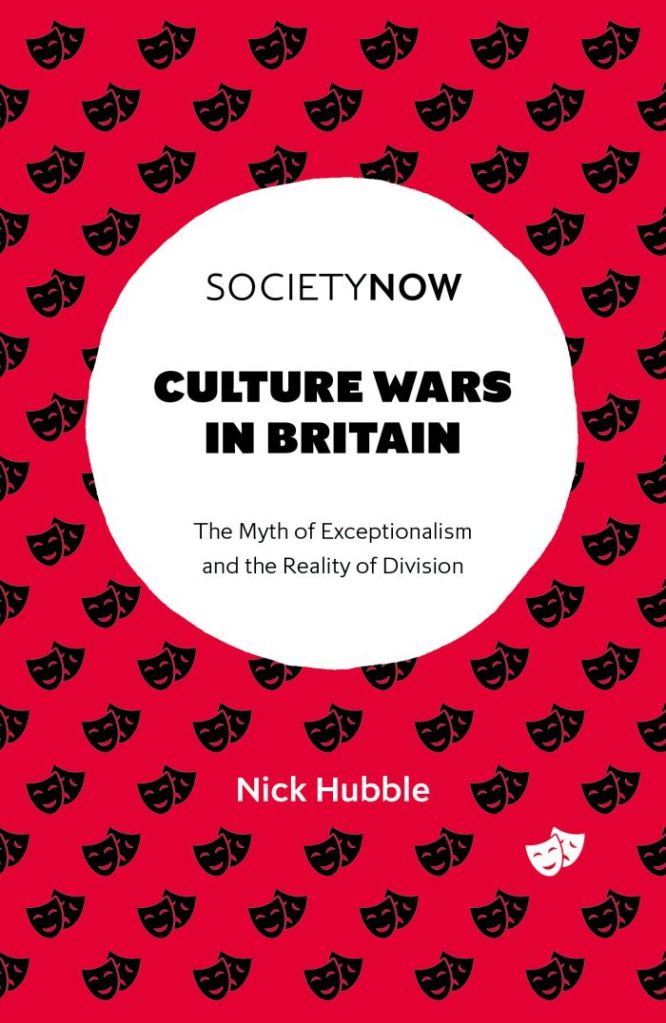
My book Culture Wars in Britain was published by Emerald Press in May. Here is the Preface, in which I situate myself and explain my motivations for writing the book.
I was born in an NHS hospital in May 1965, twenty years after the Second World War. Greater London, comprised of twelve inner and twenty outer boroughs (including my native Bromley), had come into being only weeks before. Britain’s wartime leader Winston Churchill had died back in January, a few days after the House of Commons voted to reorganize secondary education. Consequently, I would go on to attend a comprehensive school between 1976 and 1983. Meanwhile, the UK’s higher-education provision was in the process of being extensively expanded, by the addition of ‘plate-glass’ universities, such as Essex, where I would study as an undergraduate between 1989 and 1992, and Sussex, where I would gain my postgraduate degrees between 1995 and 2002. 1960s Britain was changing and everyone knew it.
But this wasn’t the first time that Britain had changed, nor would it be the last. My parents were both the youngest children of mid-to-large-size prewar families. They both had older brothers who served during the war. My dad’s parents were both born in 1899. While my grandmother worked in a munitions factory, my grandad fought in the First World War, came home and was unemployed, before getting a job with the Metropolitan Water Board and a London County Council House. He reached the position of foreman before he retired in the 1960s. Following the 1944 Education Act, my dad (born 1935) passed the Eleven Plus, and went to a grammar school, leaving at 16 with five O levels to work in a bank. My mum (born 1940) went to a secondary modern, leaving at 15 to train as a dietitian, but, when that didn’t work out, arranged a day of interviews for office jobs in London and was able to take her pick. This was 1956. Britain had full employment, and the postwar years of austerity were over.
Social and sexual attitudes were already rapidly changing when my parents married in 1962. By 1970, when my sister was born, the death penalty had been abolished, divorce liberalized, and abortion and homosexuality legalized under certain conditions. In 1973, at a time when some of the older teachers at my primary school were still regularly reminding us how lucky we were not to have to speak German, Britain joined the ‘Common Market’ of the European Economic Community (EEC). Not that I ever went to Europe as a child apart from a 4-day trip with a church youth group. We spent our family holidays in my uncle’s static caravan near Hailsham. In 1976, when I started at my local comprehensive school, Britain was, according to some metrics, the most socially equal country in the world. It was no longer a country where people needed to keep to their place according to class or gender. Our teachers, especially the younger ones, were conscious of the fact that they were educating their students for a new society.
In 1979, Margaret Thatcher’s Conservative Party came to power and instigated a further raft of economic and social changes. By 1983, when I sat my A levels, Britain had 3 million unemployed. I turned 18 just in time to vote differently to my Tory-supporting parents. Over the next few years, as I embraced causes such as anti-apartheid, unilateral nuclear disarmament, lesbian and gay rights, and the miners’ strike, our social and cultural values diverged. Making friends from other parts of Britain while studying Zoology at university in Bangor – where the native language wasn’t English but Welsh – made me realize how suburban my perspective on life was. Even so, I couldn’t handle being away from home and dropped out.
While alternating periods on the dole with dead-end jobs, I was inspired by the radically diverse politics of the Greater London Council (GLC) until the Thatcher government abolished it in 1986, following a sustained culture war of fabricated press stories mocking its anti-racist and pro-LGBT policies. I also broadened my cultural horizons by watching European films with subtitles on Channel Four, which had been launched in 1982. I remember my dad once asked me during one particularly obscure late-night offering, ‘Is this any good, Nick?’ I didn’t know. I had no criteria at that time by which to make an informed assessment. I knew I wanted it, though, whatever it was.
But even then, I didn’t go to Europe. Instead, Europe came to me. While working at a local Shaftesbury Society FE college as a classroom assistant on a community programme scheme, which paid me £20 per week on top of my social security benefits, I met a West German volunteer on her gap year. During the golden year of 1989, in which the world turned on its axis and the Berlin Wall fell, I gained an A level in English Literature in evening classes and a partner for life
My mum’s last words to me as I left home (the second time) that autumn to go to university, age 24, were ‘don’t fornicate’, despite (or possibly because of) the fact that I was going together with my girlfriend, who had decided to study in the UK. Some would say that maybe my mum had a point. By 1992, when we graduated, my girlfriend was pregnant, I was unemployed and we were still unmarried. But the times had changed; it didn’t stop us living our lives. Our oldest child was born, we completed various postgraduate degrees (with the benefit of cheap credit), we eventually got married and had a second child.
As the Britain of the 1990s segued into the 2000s, once more under a Labour Government, it seemed as though the dark days of the 1980s had finally been banished to the past. Greater London regained an elected governing body. Scotland and Wales acquired assemblies, which later became parliaments. In England, the cross of St George began to flourish in public even as the football team became increasingly multiracial. But Britain also became embroiled in the American War on Terror, fighting in Afghanistan and Iraq, despite millions of us marching in opposition.
In the aftermath of the 2007-08 global financial crisis, the UK government changed at the end of the decade and introduced austerity economics in a conscious evocation of the immediate postwar period. We went on demonstrations against the cuts. In 2012, university tuition fees were raised to a staggering £9,000 per year. Same-sex marriage was legalized with public support. The tectonic plates of British social and cultural life continued to shift.
By now, my wife and I, both full-time academics, and our three children were living in Wales, where I voted yes in the 2011 referendum for increased legal powers. I supported the yes side from afar in Scotland’s fiercely contested independence referendum in 2014, then watched some of that intensity spill over into the 2015 UK General Election, which the Conservatives won in part by running on a specifically English manifesto in England. The final act in this open emergence of division was the UK European Union membership referendum of 23 June 2016. On a personal level, the result for both myself and my wife, who didn’t even have a vote despite having lived in the UK since 1988, was devastating.
Far from living in some hypothetical ‘bubble’, we knew plenty of people who voted ‘leave’, including my dad and my best friend in academia, alongside various acquaintances, relatives and old school friends. My mum, however, voted remain and thus my parents cancelled each other’s votes out. Was there ever any tension between my wife and I and my dad resulting from this? There were a couple of touchy moments but no more than one might expect in normal family and friend gatherings anyway.
My experience of the leave voters I knew was that they voted for what they thought were good reasons and that, by and large, they were sympathetic of problems that this might have caused others and, for example, took a supportive interest in my wife’s progress in applying for a British passport. For all that our social and cultural values might be very different, in both the case of my dad and my academic friend, there was a tacit agreement that the relationship was more important than those differences; indeed, it wasn’t even a question.
Until that point, as we shall see, the term ‘culture wars’ had hardly been used in the media in a British context. Such matters were treated as an American phenomenon. Of course, attitudinal differences were tracked as part of the British Social Attitudes survey and political polling more generally. Focus groups had played a major role in New Labour’s strategy from the mid-1990s. A correlation between liberal values and the yes vote in the Scottish Independence referendum was observed and appeared again in relation to the remain vote in the EU referendum. But even in 2017, after the outcomes of both the Brexit vote and Donald Trump’s victory in the 2016 US Presidential Election, it was not yet apparent how to politically leverage these cultural divisions. Hence, the disastrous General Election campaign fought by the Conservatives under Theresa May in 2017.
Indeed, even after that election, the Conservatives were still committed to making progressive reforms to the 2004 Gender Recognition Act and carried out a public consultation on this in 2018. This was another subject of personal importance to me because since 2014 I had been publicly identifying as nonbinary. I expected that, once the reform of the GRA proved successful, legal recognition of nonbinary identities would follow. However, that wasn’t to be. A new stage in the culture wars was coming.
Following May’s replacement by Boris Johnson in 2019 and the Tories’ subsequent General Election victory in December of that year, conscious discussion of the culture wars in Britain suddenly took off. In 2020, there would be over 500 British newspaper articles focusing on the existence or nature of culture wars in the UK.
The sudden emergence of a powerful ideological narrative claiming that a silent majority of ordinary people were throwing off the shackles imposed upon them by a metropolitan elite would have been a culture shock under any circumstances. However, its combination with the Covid pandemic, which highlighted the entrenched social and economic inequalities in the UK, was surreal. Despite the fact I was working from home, rather than being furloughed, I still had plenty of time to reflect on this process by which the progressive values I had believed in and lived by had suddenly become portrayed as some sort of rootless virus, like Covid-19 itself.
Of course, other people were also thinking about these matters, and the evidence suggests that some people in positions of power in institutions, such as the BBC, actually took these criticisms on board and concluded that they had allowed themselves to become out of step with ordinary people. Suddenly, they felt guilty for imposing their own elite values. I guess being out of touch with ordinary people might be a potential worry for those who have been to elite schools and universities; especially for those who might think they are inherently more privileged than the wider public. However, I don’t know for sure because I didn’t go to an elite school or university and I’ve never considered myself inherently privileged over the wider public. Therefore, I didn’t internalize guilt for being part of some sort of conspiracy to impose liberal values upon an unwilling public. Or, indeed, succumb to the belief that any such thing had happened.
Instead, I started investigating how social change works if we assume that it is not simply imposed on a passive population by enlightened reformers but rather driven by the needs and desires of ordinary people. In investigating this matter by analyzing diaries, memoirs and other forms of life writing, including autobiographical fiction, what I discovered was a much longer and deeper British culture war dating back until at least the First World War.
As has long been understood, that war shattered the old hierarchical Victorian class system and collectively empowered ordinary working people such as my grandparents. However, a focus on the economic and political aspects of this class system has often precluded appreciation of how much of this struggle was fought over cultural terrain. Viewing social change through the prism of a century of British culture wars reveals a history that radically differs from the standard historical narratives of both right and left. Relating this longer history to the ongoing post-Brexit explosion of culture wars in the UK has turned into a major project, of which this book is the first instalment.
Why am I telling you all this? There are several reasons.
First, I am not going to pretend to be neutral in my personal beliefs because I think that’s particularly unhelpful in relation to the broader topic of cultural values and the conflicts that arise from them. Nobody is genuinely neutral in these matters; indeed, the insistence that there is some sort of objectively fair middle ground in the culture wars causes far more harm than the acceptance of there being genuine division. There is no magic solution. We are not going to return to some mythical British common culture. We urgently need to learn to live with difference.
Second, as this book will demonstrate, self-reflexivity – the capacity to think about oneself from the outside and then use this understanding to shape one’s actions – is characteristic of how people live in the modern world and shape their lives in accordance with the society around them. Self-reflexivity is what allows us to assess social norms and decide whether we want to find ways of living outside such conventions. Without conscious self-reflexivity there is no possibility of finding a new cultural pattern of living which might better accommodate difference. I’ve tried to incorporate some of my own self-reflexivity into the process of writing this book.
Third, I offer this synopsis of my story, which is not unusual for British people of my age in some respects but less common in others, because one thing we need to remember when talking to each other is that people’s cultural values and attitudes are generally underpinned by their lived experiences. When we touch upon core beliefs and personal values, we are dealing with passions that run stronger than opinions on abstract political positions. In this respect, the story of the culture wars in Britain is the story of our lives and how they have changed over the course of the last hundred years. We should all take the time to think about that.
I would like to acknowledge the support of the Leverhulme Trust, who awarded me a Research Fellowship during the academic year 2023-24 for my project, ‘Self-reflexivity, Class Consciousness, Culture Wars and Social Change in Britain’. Thanks to the respective conference organizers for allowing me to present on my research at ‘Crisis, Continuity and Change: the British Sociological Association Annual Conference’, 3-5 April 2024; and at ‘(Re-) Drawing Borders: When and Where was the United Kingdom?’, Centre for British Studies, Humboldt University, Berlin, 12-14 December 2024. I have also benefitted from arguing about ideas with colleagues at Brunel and giving my professorial lecture, ‘Culture Wars and Social Change in England’ on 23 April 2024. More generally, I need to acknowledge my good fortune over the years to have spent so much time productively discussing related ideas with academics, writers and critics in social science, modern and contemporary literature, and science fiction circles.
Thanks to all the editorial and production staff at Emerald Press for making writing this book such a rewarding and agreeable process. I would also like to express my gratitude to the three anonymous readers of the proposal for this book, who raised good points and gave helpful advice.
Last, but not least, thanks to Osian, Max and Alex and, above all else, to Andrea.


2 thoughts on “Preface to Culture Wars in Britain”